
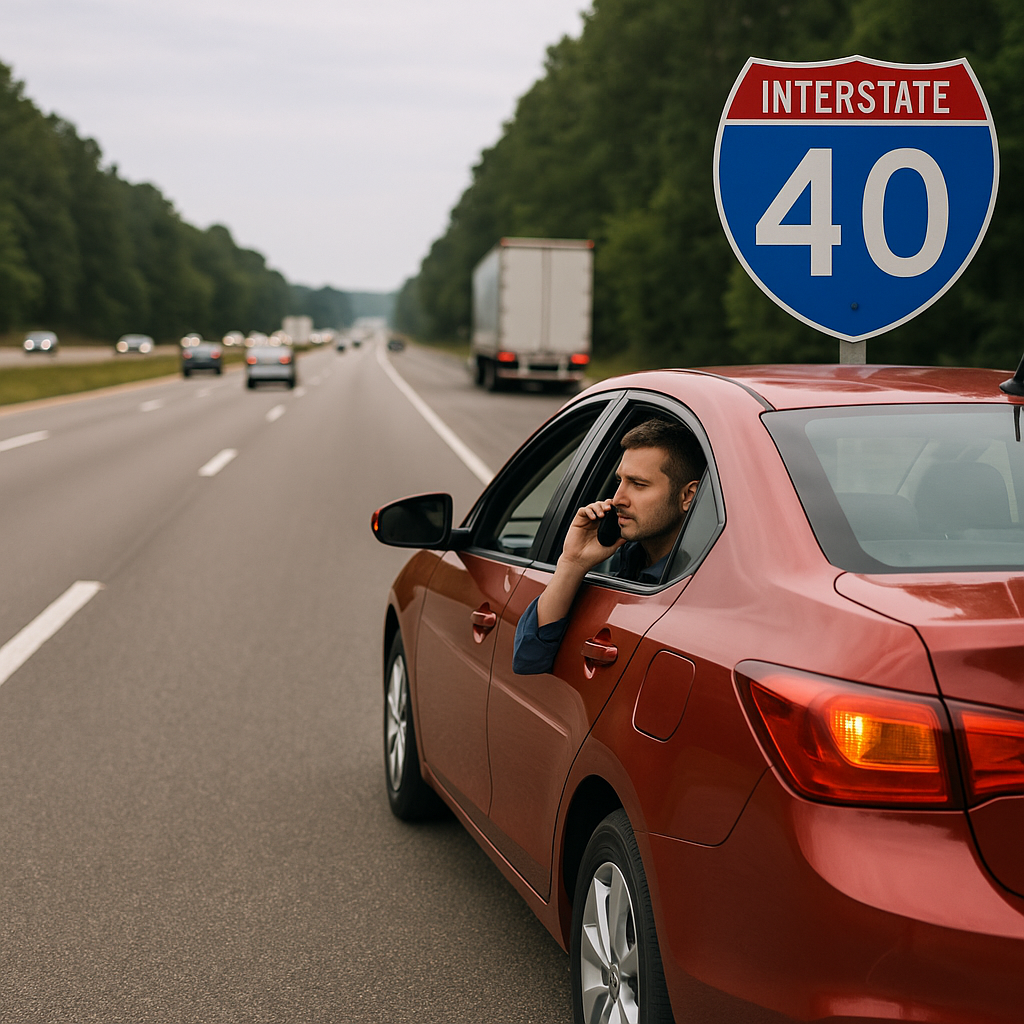
Few things spike your heart rate like losing power in the left lane of I-40 at rush hour. Around Cary, the highways that carry Cary drivers to RTP, RDU and Raleigh every day are also where most breakdowns happen, because that is where cars work hardest and where there is the least room to pull over. This guide walks you through exactly what to do, from the first warning sign to the moment the tow truck pulls away, with the local detail that matters on I-40, I-540, US-1 and Cary Parkway.
The first 60 seconds: get out of traffic
The moment your car stumbles, surges, or the dash lights up, your only job is to get to the right shoulder or an exit ramp while you still have momentum. Do not brake hard; ease off the gas, signal right, and drift across one lane at a time. A car that has lost power will still coast a surprising distance if you keep it rolling.
- Hazards on immediately. Even in daylight. Other drivers need every second of warning they can get.
- Aim for the widest shoulder you can reach. On I-40 between Harrison Avenue and Wade Avenue, and on I-540 near the airport, the shoulders are generally full width. On some US-1 stretches south of Cary and on Cary Parkway, the shoulder narrows or disappears, so an exit ramp, a side street or a parking lot is a better target.
- If you can make an exit, take it. A gas station lot off Harrison Avenue or Aviation Parkway is a far safer place to wait than the interstate shoulder.
Where breakdowns happen most around Cary
Every tow operator who works Wake County knows the same handful of spots. If you drive them daily, it pays to know them too.
- I-40 between Harrison Avenue (Exit 287) and Wade Avenue (Exit 289). Heavy merging, stop-and-go traffic and hot afternoons make this the number one place for overheating and stalled cars.
- The I-40 / I-540 interchange near RDU. Speeds are high, lanes shift, and a flat tire here is a serious situation. Get to the shoulder and stay in the car.
- US-1 / US-64 through Cary and Apex. Long grades and frequent lights are hard on older cooling systems and tired batteries.
- Cary Parkway and Maynard Road. Not highways, but busy enough that a dead car at a light backs up traffic fast. Push to a side street if you have help and it is safe.
Stay in the car or get out?
This is the question that gets people hurt. The answer depends on where you are.
- On an interstate or highway shoulder: stay inside with your seat belt on unless the car is on fire or in the travel lane. The shoulder of I-40 is one of the most dangerous places you can stand. Exit only from the passenger side, and only if you must.
- On a narrow or partial shoulder: if part of your car is still in the lane and traffic is moving, it is usually safer to get well off the road, behind a guardrail if there is one, and call from there.
- In a parking lot or side street: you can get out, but stay off the pavement and keep kids and pets inside.
Call for help the smart way
Once you are stopped safely, call a local towing company directly. When you call the featured provider, WTF Towing, at (919) 230-4498, a dispatcher answers 24 hours a day and will ask a few quick questions. Having answers ready shortens the wait.
- Exact location. On the interstate, give the direction of travel and the nearest exit number or mile marker (the small green signs every two-tenths of a mile). On surface streets, a cross street or a business name works.
- Vehicle details. Year, make, model and color, plus anything that affects the tow: all-wheel drive, lowered suspension, an electric vehicle, or a trailer.
- What happened. “It died and won’t crank,” “the temperature gauge pegged,” or “I heard a bang and it pulls hard” all point the driver toward the right truck and tools.
- Where you want it to go. Home, your mechanic in Cary, a dealership in Raleigh. You choose the destination.
The five most common reasons Cary drivers need a tow
Knowing the likely cause helps you describe the problem and sometimes avoid the tow altogether.
1. A dead or dying battery
Batteries in the Triangle rarely last past four years. Summer heat cooks them, and the first cold morning in November finishes them off. If the car clicks or the lights dim when you turn the key, it is almost always the battery. A jump start may get you going; if it dies again within a few miles, it needs a tow to a shop.
2. Overheating
Stop-and-go traffic on I-40 in July is brutal on cooling systems. If the temperature gauge climbs into the red, pull over and shut the engine off. Driving even another mile can turn a $200 hose into a $4,000 head gasket job. Read the guide on what to do when your car overheats.
3. Flat tires and blowouts
Debris on I-540 and construction zones along US-1 claim a lot of tires. If you have a usable spare and a safe spot, a tire change is quick. On a highway shoulder, it is safer to let a professional do it with a truck blocking traffic behind you.
4. Running out of fuel or charge
It happens to careful people. Fuel gauges lie, and range estimates on EVs drop fast at highway speed with the air conditioning running. A fuel delivery is faster and cheaper than a tow.
5. Mechanical failures
Broken belts, failed alternators, transmission trouble and blown radiator hoses. These are the real “you need a truck” situations. Do not keep trying to restart a car that made a loud noise and quit; you can turn a repair into a replacement.
While you wait
- Keep hazard lights on. If you have reflective triangles, set them out only if you can do it safely from the non-traffic side.
- Stay buckled if you are on the highway shoulder. Keep the doors locked and crack a window for air.
- Keep your phone charged and answer unknown numbers. The driver may call for a better description of your location.
- At night, turn on the interior dome light so the driver can spot you.
- Gather what you need from the car: wallet, phone, medications, garage door opener, child seats. Once it is loaded, it is not convenient to dig through.
What happens when the truck arrives
The driver will position the truck behind you with the light bar on to shield the scene, ask you to confirm the destination, and load the car. Most passenger cars in Cary go on a flatbed. All-wheel-drive vehicles and EVs must be carried on a flatbed rather than dragged, so mention them when you call. You will usually get a price before the car moves, and you can ride along in the truck to the shop in most cases.
Frequently asked questions
Should I try to restart the car on the highway? Once you are safely stopped, one attempt is fine. If it does not start, or it starts and immediately runs rough, stop trying and call.
Can I leave my car on the shoulder and come back later? On interstates, an abandoned car may be tagged and towed by the state or a police-rotation wrecker within a day or two, and getting it back is expensive. It is better to arrange your own tow.
What if the police arrive first? Officers may call a rotation tow if the car is blocking traffic. If you have already called your own tow company and it is on the way, tell them; in most non-crash situations you can wait for the truck you chose.
Does the featured provider cover Apex, Morrisville and RTP too? Yes. WTF Towing serves Cary, Apex, Morrisville, Holly Springs, New Hill and Research Triangle Park, including every stretch of I-40, I-540, US-1 and US-64 in between.
WTF Towing – 24/7 towing and roadside help in Cary, NC.
Answered 24/7 · WTF Towing in Cary