
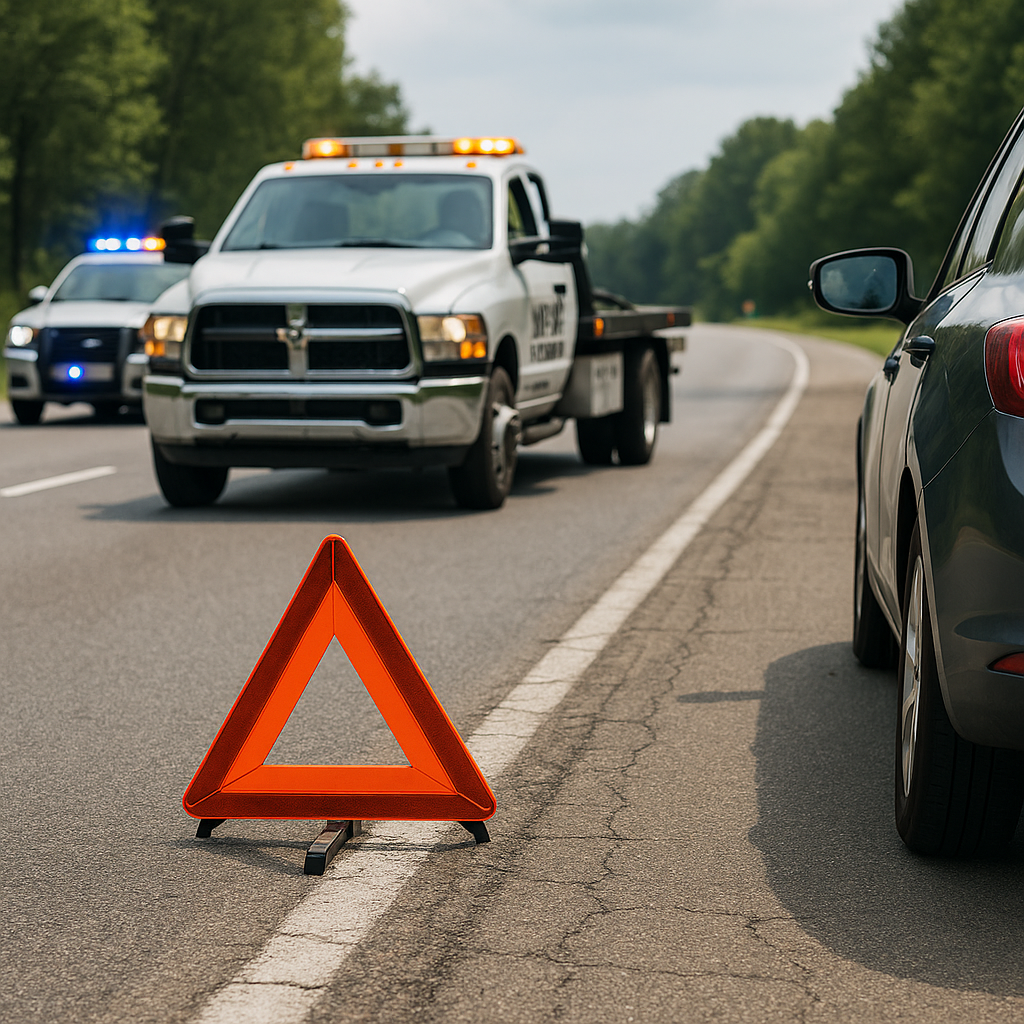
Every tow operator in Cary has a story about the mirror that missed them by a foot on the shoulder of I-40. North Carolina’s Move Over law exists because too many of those stories did not end with a near miss. If you drive in Wake County, the law applies to you every time you pass flashing lights, and the penalties are real. Here is what the law requires, who it protects, how it plays out on the specific roads around Cary, Apex and Morrisville, and why the drivers who tow your car care about it so much.
What the law says
North Carolina’s Move Over law (General Statute 20-157) requires that when you approach a stopped vehicle displaying flashing lights on or near the roadway, you must:
- On a road with two or more lanes in your direction: move over into a lane that is not next to the stopped vehicle, as soon as it is safe to do so. If you cannot move over because of traffic, slow down, maintain a safe speed and be prepared to stop.
- On a two-lane road (one lane each way): slow down, maintain a safe reduced speed, and be prepared to stop.
The law originally covered police, fire and EMS. It was expanded to cover tow trucks, wreckers and roadside recovery vehicles displaying amber lights, along with utility and highway maintenance vehicles. In other words, the flatbed with its amber bar flashing on the shoulder of US-1 has the same legal protection as a patrol car with blue lights.
Penalties
A basic Move Over violation in North Carolina is an infraction carrying a fine of $250 plus court costs. If the violation causes property damage or injury to an emergency worker or responder, it becomes a Class 1 misdemeanor with a substantially higher fine; if it causes serious injury or death, it can be charged as a felony. Insurance points and license points follow a conviction. None of that is worth the four seconds you save by not changing lanes.
Why it matters for tow truck operators
A police officer at a traffic stop is usually standing at the driver’s window, on the shoulder side of the stopped car. A tow operator has to work on the traffic side: hooking a car, running a winch line, kneeling to attach straps to a wheel that faces the travel lane. They are often there for fifteen or twenty minutes, at night, in the rain, with their back to traffic. Nationally, tow operators are struck and killed on the roadside at a rate far higher than most people realize. The amber lights are not decoration. They are a request to give the person behind them room to go home.
How it plays out around Cary
I-40 through Cary and toward RTP
Three and four lanes each way, heavy traffic, and stopped vehicles on the right shoulder every day. Moving over is usually possible; the mistake drivers make is waiting until they are on top of the scene. Start signaling as soon as you see the lights ahead, not when you can read the truck’s license plate.
I-540 near the airport
High speeds and a gentle curve near the Aviation Parkway and I-40 interchanges mean drivers come up on shoulder scenes fast. Slow down early. If a truck is working a car on a curve, the operator may be stepping into the lane to see traffic.
US-1 / US-64 between Cary and Apex
Two lanes each way in most places, with narrower shoulders than the interstates. Moving over here often means moving into the left lane while everyone else is doing the same; if you cannot, slow down substantially. This corridor has more close calls than any other road we work.
NC-55, Cary Parkway, Davis Drive and other two-lane stretches
You cannot move over, so the law asks you to slow down and be ready to stop. Drivers tend to forget the law applies on surface streets at all. It does.
I-440 in Raleigh
Cary drivers headed to the fairgrounds, PNC Arena or downtown use the Beltline constantly. It is tight, curved and busy, with short shoulders in places, and stopped vehicles appear with little warning. Leave a gap in front of you so you have room to react.
Common mistakes
- Slowing down but not moving over when a lane was available. On multi-lane roads the law expects both when possible.
- Moving over at the last second and cutting off the car beside you. Plan the lane change early.
- Assuming it is only for police. Tow trucks, utility trucks and DOT vehicles with amber lights are covered.
- Rubbernecking. Looking at the scene means you are not looking at the car in front of you that just braked.
- Passing a scene on the shoulder to get around slowed traffic. Illegal, and the single most dangerous thing you can do to a roadside worker.
If you are the one stopped on the shoulder
The same principles protect you while you wait for a tow. Stay in the car with your seat belt on, hazards flashing. Keep the wheels turned away from traffic so that if the car is struck it moves onto the shoulder rather than into the lane. When the tow truck arrives, the driver will park behind you with the light bar on, using the truck as a shield. Follow the driver’s instructions about which side to exit from; there is a reason for them. Our full guide: what to do when you break down on I-40, I-540 or US-1.
Teaching new drivers
If you have a teenager learning to drive in Cary, the Move Over law is one of the easiest habits to build early: lights ahead, signal now, move left, ease off. Point out every shoulder scene you pass together and talk through the lane change. It becomes automatic, and automatic is what saves lives at 65 mph.
Frequently asked questions
Does the law apply to tow trucks? Yes. Tow trucks and wreckers displaying amber warning lights are covered under North Carolina’s Move Over law.
What if I cannot safely move over? Slow down to a safe speed well below the limit and be prepared to stop. The law recognizes that a lane change is not always possible; it does not excuse maintaining speed.
Does it apply on surface streets? Yes. On any road, you must at minimum slow down for a stopped vehicle with flashing lights.
How much is the fine? $250 plus court costs for a basic violation, with much higher penalties if anyone is hurt or property is damaged.
Does the law cover a stopped car with hazard lights but no emergency vehicle? The statute is written around emergency, utility and recovery vehicles with warning lights. Common sense and basic decency say give a stranded car room too.
From every driver at WTF Towing: thank you for moving over. Call (919) 230-4498 if you are the one who needs help on the shoulder.
WTF Towing – 24/7 towing and roadside help in Cary, NC.
Answered 24/7 · WTF Towing in Cary