

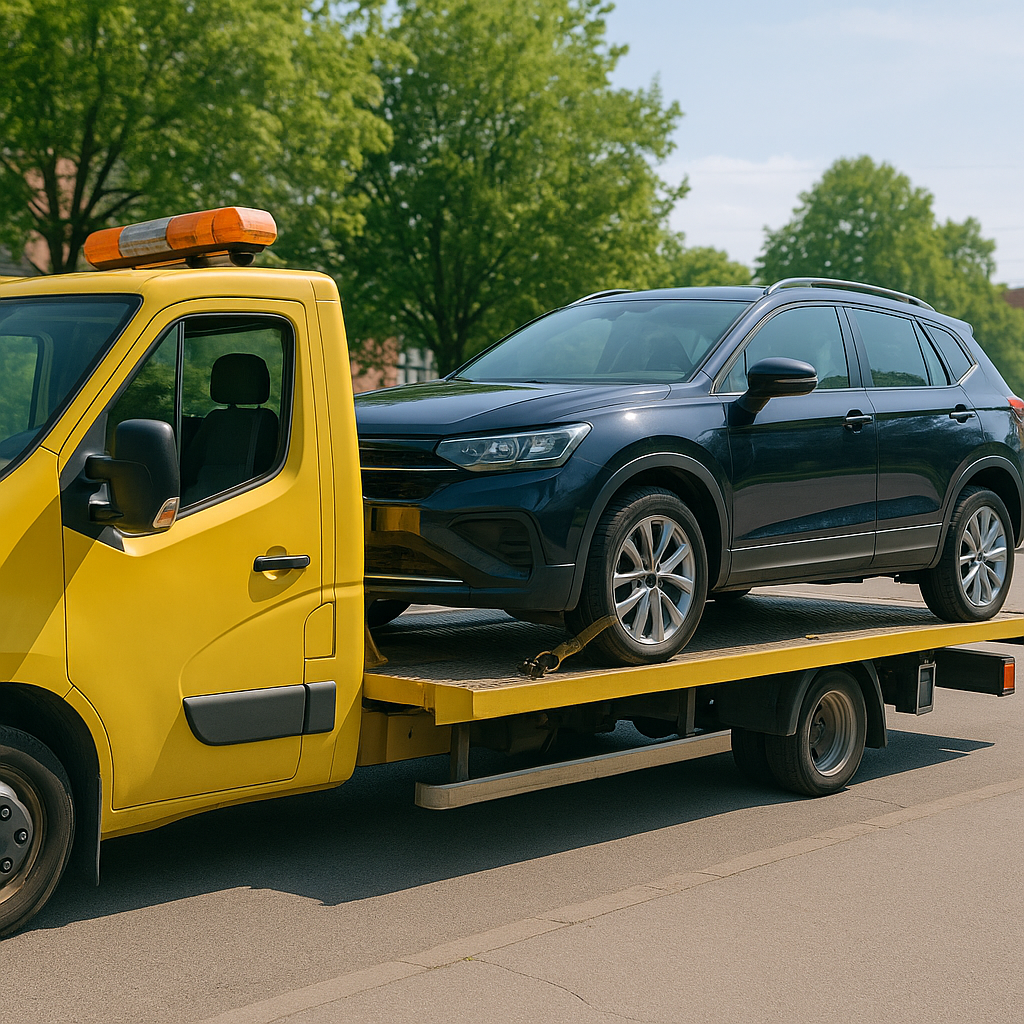
Nobody budgets for a tow, so the price is the second thing people ask about after “how long.” The fair answer is not a single number. Two tows that look identical from the shoulder can cost very different amounts depending on distance, the truck required and the situation. What you should expect from any towing company in Cary is a clear price before the truck rolls, no surprises at drop-off, and an explanation of what you are paying for. Here is how towing pricing works, what pushes it up or down, and how to avoid paying more than you should.
How a tow is priced
Most towing bills in the Triangle have two parts.
- A hook-up (base) fee. This covers sending the truck, the driver’s time to load your car safely, and the first stretch of distance. It applies whether the tow is one mile or ten.
- A per-mile charge for loaded miles beyond what the base fee includes, from where the car is picked up to where it is dropped off, not from the truck’s starting point.
Roadside services that do not involve moving the car, such as a jump start, a tire change, fuel delivery or a lockout, are priced as a flat service call and are less than a tow.
What makes a tow cost more
- Distance. A tow from Crossroads to a shop on Chatham Street is short. A tow from New Hill to a dealership in north Raleigh is not. Distance is the biggest variable.
- Recovery work. If the car is in a ditch, stuck in mud, or off the shoulder, it has to be winched back to solid ground before it can be loaded. Winching is billed separately, usually by time, because a simple pull and a two-hour recovery are very different jobs.
- The truck required. All-wheel drive, EVs and low cars need a flatbed. Very heavy vehicles need a heavier truck. The right equipment is part of the price.
- Access. A car in a tight parking deck, a steep driveway or behind a locked gate takes more time and sometimes two steps (a wheel-lift to pull it out, a flatbed to carry it).
- Condition of the car. A car that cannot roll or steer after a collision has to be winched and sometimes dollied. It takes longer.
- Time and conditions. Some companies add after-hours or holiday charges. Ask, so you know.
- Waiting. If the driver has to wait for you, for police to clear a scene, or for a gate to be opened, some of that time may be billed.
What should not be on your bill
- Charges that were not mentioned when you called.
- Mileage measured from the truck’s garage instead of from your car.
- “Fuel surcharges,” “administrative fees” or “equipment fees” that appear only at drop-off.
- Storage fees, if the car went straight to your shop or home. Storage applies only when a car sits in a towing company’s lot.
- A different total from the one you were quoted, unless the job genuinely changed (for example, you asked to go somewhere farther, or the car turned out to need winching).
Storage fees: the cost nobody expects
If your car is towed after a crash by a police-rotation wrecker and you did not choose the destination, it usually goes to that company’s storage lot. Daily storage charges start immediately and continue until you retrieve it, and lots often have limited hours. The way to avoid this is to arrange your own tow whenever you are able to, and to have the car taken directly to your shop or home. Read more in predatory towing and your rights in Cary.
Roadside programs and insurance
Many drivers have towing coverage through an insurance policy, a credit card, a car manufacturer’s warranty program or a membership club. These can reduce or eliminate your out-of-pocket cost, but read the fine print: most cover a limited number of miles, a limited number of calls per year, and sometimes only tows to the nearest shop rather than the one you prefer. Some let you call any tow company and submit the receipt for reimbursement, which is often faster than waiting for the program to dispatch someone. The trade-offs are covered in is your towing coverage enough?
How to get a fair price
- Call a local company directly and ask for the total to your destination before anyone is dispatched.
- Give accurate information. The drivetrain, whether the car rolls, and where it is. A quote based on wrong information will change, and that is not the tow company’s fault.
- Pick the destination before you call. Changing your mind mid-tow changes the mileage.
- Consider a roadside fix first. If it is a dead battery or a flat with a good spare, a jump or a tire change is cheaper than a tow, and the dispatcher should tell you so.
- Ask about payment. Most tows are paid at the time of service by card. Know that before the truck arrives.
- Get a receipt with the company name, the mileage and the services listed. You will need it for insurance or reimbursement.
How the featured provider prices a job
When you call WTF Towing at (919) 230-4498, the dispatcher asks where you are, what the car is, what happened and where it needs to go, then gives you a price for that job. That is the price. If the situation turns out to be different from what was described (the car is in a ditch, not on the shoulder), the driver explains the difference before doing the extra work. They serve Cary, Apex, Morrisville, Holly Springs, New Hill and RTP, and would rather lose a job by being honest about the number than win it by surprising you at drop-off.
Frequently asked questions
Can I get a price over the phone? Yes. That is how it should work. If a company will not, call someone else.
Is a short tow cheaper than a jump start? No. Roadside services are less than a tow. If a jump will fix it, that is the cheaper call.
Is there a charge if the roadside fix doesn’t work? If the roadside service does not solve the problem and you need a tow, the tow is priced as a tow. Ask the dispatcher how that works for your situation.
Do I pay the driver or the office? The driver, at the time of service, in most cases.
Will my insurance pay the tow company directly? Some programs do; many reimburse you afterward. Bring the receipt to your insurer.
WTF Towing – 24/7 towing and roadside help in Cary, NC.
Answered 24/7 · WTF Towing in Cary