

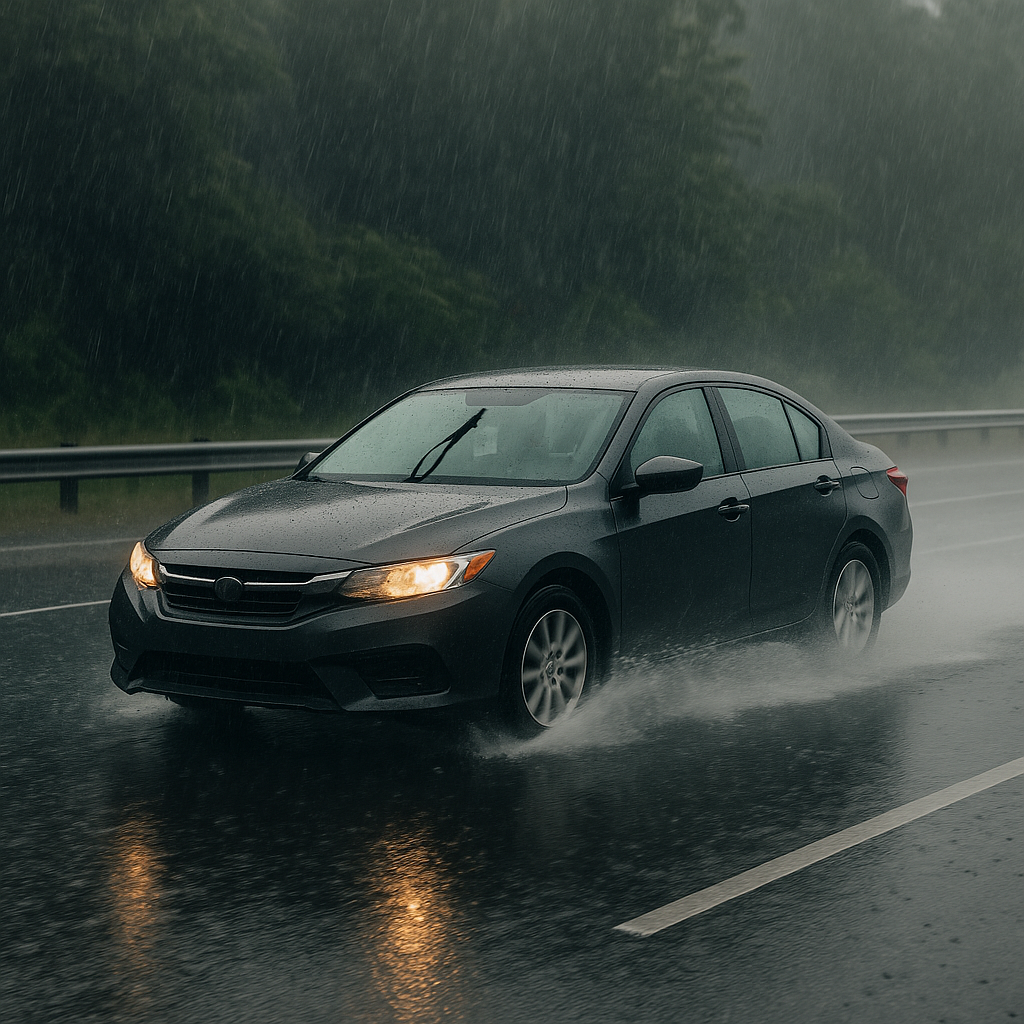
The first heavy rain after two dry weeks turns Cary’s roads into a skating rink, and the calls come in bunches: a car spun into the ditch on I-540, a sedan hydroplaned into the barrier on Wade Avenue, a pickup stalled in two feet of water under a railroad bridge. Rain is the most common weather Cary gets and the one drivers underestimate most. This guide covers how hydroplaning actually happens, the spots around Cary where it happens most, how to handle a skid, why flooded roads are more dangerous than they look, and how to prepare for the storms that roll through every summer and fall.
How hydroplaning works
Tires are designed to channel water out through the grooves in the tread. When there is more water than the grooves can move, a wedge of water builds up in front of the tire, lifts it off the pavement, and you are suddenly driving a sled. It can start at speeds as low as 35 mph in standing water, and it is far more likely with worn tires, underinflated tires, and higher speed. The first few minutes of a rain are the worst, because oil and rubber dust on the pavement float to the surface before the rain washes them away.
Signs you are hydroplaning: the steering suddenly feels light, the engine note rises as the drive wheels spin, or the rear of the car starts to drift.
What to do when it happens
- Do not brake. Locked or braking wheels have no chance of regaining grip.
- Ease off the gas gently. Do not lift abruptly, especially in a rear-wheel-drive car.
- Keep the wheel pointed where you want to go. Small inputs. If the rear steps out, steer gently in the direction the rear is sliding.
- Wait. Hydroplaning usually lasts a second or two. As the car slows, the tires reconnect. Then correct smoothly.
- Once you have grip, slow down and increase your following distance. Whatever speed you were doing was too fast for the water.
Where it happens most around Cary
- I-40 between Harrison Avenue and Wade Avenue. Worn wheel ruts hold water in the right and center lanes. The left lane is often drier.
- Wade Avenue and I-40 East toward Raleigh. Curves plus ruts plus speed. This stretch produces spinouts in every heavy rain.
- I-540 between NC-55 and Aviation Parkway. Long, slightly banked curves where water sheets across the lanes.
- US-1 / US-64 through Cary and Apex. Long downhill grades where water runs across the road toward the shoulder.
- NC-54 and Davis Drive toward RTP. Older pavement, deep ruts, and standing water in the low sections.
- Cary Parkway at the low points near creeks. Puddles that look shallow and are not.
Driving in rain: the habits that keep you out of the ditch
- Slow down by at least 10 mph below what you would do dry, more in heavy rain. Speed is the single biggest factor.
- Double your following distance. Wet stopping distances are far longer, and the car ahead may hydroplane too.
- Drive in the tracks of the car ahead, where the water has already been pushed aside.
- Avoid the outside lanes on curves and the ruts on straightaways. Water collects there.
- Turn off cruise control. If the car hydroplanes with cruise on, it can accelerate the drive wheels at exactly the wrong moment.
- Headlights on, always, and wipers ahead of the rain, not behind it.
- Check your tires. Tread depth under 4/32″ is where hydroplaning risk climbs sharply. Pressure matters too; see the tire pressure and flat tire guide.
Flooded roads: turn around, don’t drown
Cary sits on rolling terrain laced with creeks, and a two-inch downpour puts water across roads that are dry the rest of the year. The dangerous ones are the low spots near Crabtree Creek, Swift Creek and Walnut Creek, underpasses, and any road that dips between two hills. The rules are simple and people break them every storm:
- Six inches of moving water can sweep a person off their feet. Twelve inches can float most cars. Two feet will carry away an SUV or pickup.
- You cannot see the road under the water. The pavement may be gone.
- Water that reaches the bottom of the doors is enough to stall the engine by flooding the air intake. Once a modern engine ingests water, it can be destroyed instantly (hydrolock), and that is a total loss on most cars.
- If your car stalls in water that is not rising, stay put and call for help. If the water is rising, get out through a window and to high ground. Do not wait.
A car that has been in floodwater to the floorboards should be towed, not driven, even if it starts. Water in the transmission, the differentials, the wiring harnesses and the interior does damage that shows up over the following weeks.
Storms, hurricanes and the days after
When a tropical system tracks through the Triangle, the towing calls come in three waves: the day before (people leaving late with cars that were already marginal), during (stalled and flooded cars, cars in ditches), and the two days after (trees on cars, cars stuck in mud on soft shoulders, batteries that died while cars sat). A few things help:
- Fill the tank before the storm. Gas stations lose power too.
- Do not park under large trees or in low spots for the duration.
- Charge your phone and your jump pack.
- If you must drive, plan a route that avoids the known low crossings and give yourself twice the time.
- After the storm, watch for washed-out shoulders. A shoulder that held a truck last week may be soft mud now. If you go in, do not spin the wheels; you will dig in. Call for a winch-out.
If you end up in the ditch
Turn on your hazards, stay in the car if it is stable and you are away from traffic, and call. A car in a ditch off I-540 or US-1 is a recovery job, not a simple tow: it needs to be winched back to the pavement carefully to avoid more damage, then loaded. Tell the dispatcher how far off the road you are, whether the car is on its wheels, and whether anyone is hurt. The featured provider, WTF Towing, handles rain and storm recoveries across Cary, Apex, Morrisville, Holly Springs and RTP, 24 hours a day, at (919) 230-4498.
Frequently asked questions
Is all-wheel drive safe in the rain? AWD helps you accelerate on wet roads. It does nothing to help you stop or turn, and it does not prevent hydroplaning. Tires and speed matter far more.
Should I drive through a puddle if other cars are? Only if you can see the road surface and the water is clearly shallow. Larger vehicles can cross water that will stall yours.
My car stalled in water but started again. Is it fine? Have it inspected. Water in the oil, transmission fluid or wiring can cause failures weeks later.
Can a car be towed out of floodwater? Once the water has receded enough to reach it safely, yes. Never stand in floodwater to wait for a truck.
WTF Towing – 24/7 towing and roadside help in Cary, NC.
Answered 24/7 · WTF Towing in Cary