
A flat tire on the I-540 Beltline at 70 mph and a slow leak discovered in your driveway on Green Level Church Road are the same mechanical problem and completely different safety problems. This guide covers both: how to keep control of a blowout, where and whether to change a tire yourself, why the “donut” spare has an expiration date most people ignore, how tire pressure works with Cary’s seasons, and when the right move is to stay in the car and call.
Handling a blowout at highway speed
A blowout sounds like a gunshot followed by a rumble, and the car pulls hard toward the flat. Everything your instincts tell you to do is wrong.
- Do not brake hard. Braking shifts weight and makes the pull worse. Keep your foot steady, even a little on the gas for a second, to keep the car stable.
- Grip the wheel and steer straight. Small corrections. The car wants to swerve; you want to keep your lane.
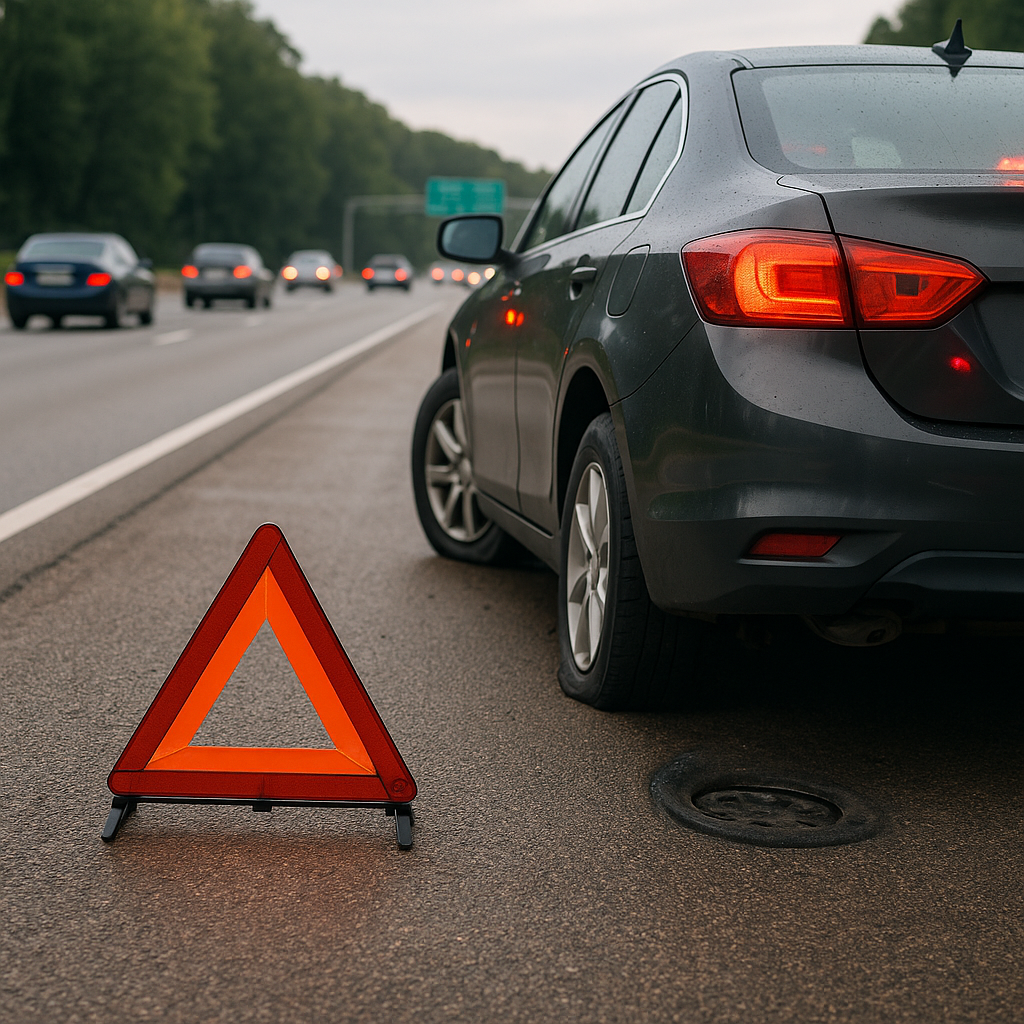
- Let it slow on its own, then signal and move to the right shoulder. Hazards on.
- Stop as far right as possible. On I-540 between Davis Drive and the airport, and on I-40 through Cary, the shoulders are wide. On US-1 south of Tryon Road and on parts of NC-55, they are not; if the shoulder is narrow, an exit ramp is worth the extra quarter mile on a flat. A ruined rim is cheaper than a ruined afternoon.
Change it yourself or call?
Changing a tire is a fifteen-minute job in a driveway. On a highway shoulder it is one of the more dangerous things an ordinary driver ever does, because the flat is usually on the traffic side and you are kneeling with your back to 70-mph traffic. Here is the honest rule:
- Change it yourself if you are in a parking lot, a side street or a driveway, you have a usable spare and a jack that fits the car, and the ground is flat and firm.
- Call for help if you are on an interstate, US-1, US-64 or any road where the flat side faces traffic; if it is dark or raining; if the lug nuts will not budge (they are often over-tightened by impact wrenches at tire shops); if the spare is flat too; or if you simply are not comfortable. A tow truck parked behind you with its light bar on is the protection you do not have alone.
A roadside tire change from the featured provider, WTF Towing, puts a professional with a proper jack, a breaker bar and traffic protection at your car. If your spare is bad or the car has no spare at all, the same truck can tow you to a tire shop instead. See tire change service.
Changing a tire safely: the short version
- Park on firm, level ground, in park, parking brake set, hazards on. Block the opposite wheel if you can.
- Loosen the lug nuts a half turn while the tire is still on the ground.
- Jack at the manufacturer’s lift point (check the manual; on many cars it is a notch in the pinch weld behind the front wheel). Never put any part of your body under the car.
- Remove the nuts and the flat, mount the spare, thread the nuts on by hand, snug them in a star pattern.
- Lower the car, then tighten firmly in the same star pattern.
- Check the spare’s pressure at the first station. Compact spares need 60 psi, and most have about 20 by the time they are needed.
The donut spare: when it is time to replace it
Compact spares are meant for 50 miles at 50 mph, but the bigger problem is age. Rubber hardens and cracks whether it is used or not. Look for the four-digit DOT date code on the sidewall; the last two digits are the year. A spare older than about ten years should be replaced even if it has never touched pavement. Check the pressure twice a year while you are at it. A flat spare is the reason for a surprising share of the tow calls that come from people who did everything else right.
Many newer cars have no spare at all, just a can of sealant and a small compressor. Sealant works on a simple puncture in the tread and does nothing for a sidewall cut or a blowout. If your car is one of these, a roadside tire change is not an option and a tow to a tire shop is the plan. Know which kind of car you have before you need to.
Tire pressure through Cary’s seasons
Tire pressure drops about one psi for every 10°F the temperature falls. A tire set to 35 psi on an August afternoon can be under 30 on the first frosty November morning, which is exactly when the tire pressure light comes on across the Triangle. Low pressure builds heat, wears the shoulders of the tread and is the leading cause of blowouts.
- Use the pressure on the door-jamb sticker, not the number on the tire sidewall (that is the maximum, not the target).
- Check monthly and before long trips, when the tires are cold.
- If the TPMS light blinks for a minute and then stays on, the system itself has a fault, usually a dead sensor battery, and the light will not tell you about a real low tire until it is fixed.
- Nitrogen fills are fine but not magic; they still lose pressure with temperature.
Slow leaks and hidden dangers
A tire that needs air every week has a nail, a cracked valve stem or a corroded wheel bead. Get it looked at. Around Green Level Church Road, Highway 55 and the new subdivisions west of Cary, construction debris is a constant source of screws and nails, and a slow leak that gets ignored becomes a blowout on the Beltline. Also check for bulges in the sidewall after hitting a pothole; a bulge means the inner cords are broken and the tire can fail at any speed.
Where flats happen most around Cary
- I-540 between NC-55 and Aviation Parkway: debris from the truck traffic to and from the airport.
- I-40 construction zones: shifted lanes, steel plates and sharp curb edges.
- US-1 / US-64 through Apex: long ramps and frequent tire carcasses in the road.
- New-construction neighborhoods off Green Level, Carpenter Fire Station and Morrisville Parkway: nails and screws.
What to tell the dispatcher
Where you are (road, direction, exit or mile marker), which tire is flat, whether you have a usable spare, and whether the flat side faces traffic. That last detail tells the driver how to position the truck. Call (919) 230-4498; the featured provider, WTF Towing, serves Cary, Apex, Morrisville, Holly Springs and RTP, 24 hours a day.
Frequently asked questions
Can I drive on a flat to the next exit? A short distance at low speed to reach safety is worth a ruined tire and maybe a rim. Do not drive miles on it.
Will they bring me a new tire? Roadside service changes to your spare or tows you to a tire shop. Tow trucks do not carry tires.
My lug nuts have a lock and I lost the key. Tell the dispatcher. It may still be possible to remove them roadside, but often the car needs to go to a shop.
Do run-flat tires need a tow? Most run-flats are rated for about 50 miles at 50 mph with no pressure. That will get you to a shop; it will not get you to Charlotte.
WTF Towing – 24/7 towing and roadside help in Cary, NC.
Answered 24/7 · WTF Towing in Cary