
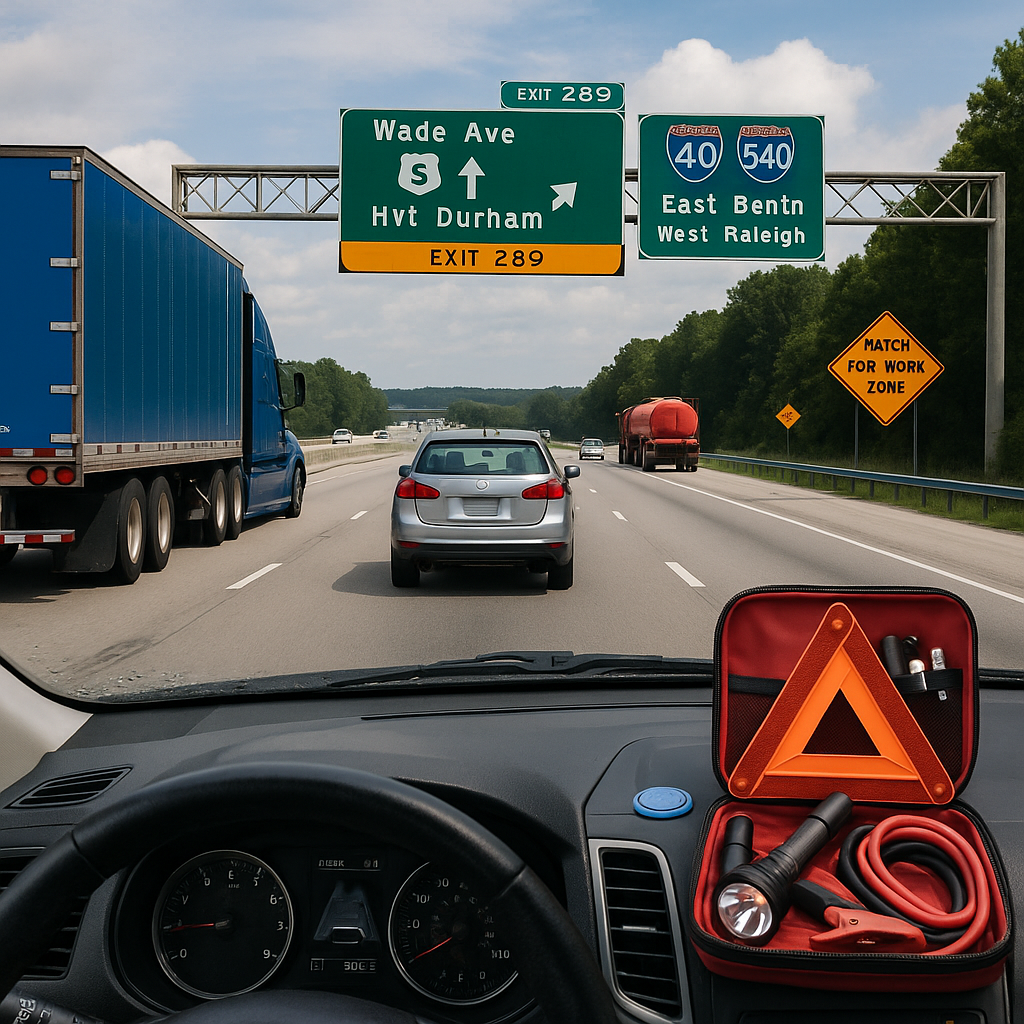
I-40 and I-540 are the two roads almost every Cary driver uses, and between them they generate the majority of the highway breakdown and crash calls we answer. Neither is unusually dangerous; they are just busy, fast, and full of drivers doing the same commute on autopilot. These are the habits that keep you out of trouble on both, drawn from what we see on the shoulder every week, plus a section on what to do the moment something goes wrong.
1. Leave a real gap
The single biggest cause of the chain-reaction crashes on I-40 between Harrison Avenue and Wade Avenue is following distance. At 65 mph, two seconds behind the car ahead is about 190 feet, and most drivers in the afternoon rush are running well under that. When the lead car brakes for a merge, everyone behind goes into the trunk in front of them. Count “one thousand one, one thousand two” from when the car ahead passes a sign to when you do. If you get there first, you are too close. Double it in rain.
2. Know the merges
Certain merges on both interstates cause the same problems every day:
- I-40 East at Harrison Avenue (Exit 287): a short ramp into heavy traffic. Use the whole ramp to get up to speed; do not stop at the end of it.
- I-40 at Wade Avenue (Exit 289): the left-side ramp and the weave with traffic bound for I-440. Get into your lane early and stay there.
- I-40 / I-540 interchange (Exit 283): multiple lanes split; last-second lane changes here cause sideswipes weekly.
- I-540 at Aviation Parkway and at NC-55: airport traffic in a hurry and commuters who forget the exit is coming.
The rule is simple: pick your lane a mile early, and if you miss the exit, take the next one. Crossing three lanes in a hundred yards is how people end up on our flatbed.
3. Do not drive in the ruts in the rain
The right and center lanes on I-40 through Cary are worn into shallow troughs that hold water. In rain, that standing water causes hydroplaning at ordinary speeds. Move a few feet left or right of the ruts within your lane, slow down, and turn off cruise control. Our rain and hydroplaning guide covers the details.
4. Watch the temperature gauge in stop-and-go
Summer afternoons on I-40 westbound, stopped from Wade Avenue to the RTP exits, cook marginal cooling systems. If the gauge starts climbing, turn off the air conditioning and turn the heater on high to pull heat out of the engine. If it keeps climbing, get to the shoulder and shut down. Another mile can be the difference between a hose and a head gasket. More in what to do when your car overheats.
5. Check the tires before the highway, not on it
Blowouts at 70 mph are almost always preventable: an underinflated tire, a tire with a bulge from a pothole, or a tire that was worn to the cords. Pressure once a month, a visual check for bulges after any hard curb strike, and tread depth above 4/32″. If a blowout happens anyway, do not brake hard; hold the wheel straight, ease off the gas, and let the car slow before moving to the shoulder. Full details in the flat tire guide.
6. Move over for flashing lights
Police, fire, EMS, DOT trucks and tow trucks with amber lights on the shoulder: move a lane away if you can, slow down substantially if you cannot. It is the law in North Carolina, the fine starts at $250, and the person on the shoulder may be the one who tows your car next month. See the Move Over law guide.
7. Put the phone down
The distracted-driving crashes we see on I-540 are distinctive: no skid marks, a car that drifted into the barrier or the car ahead at full speed. Texting while driving is illegal in North Carolina, and at 70 mph a five-second glance covers more than 500 feet. Mount the phone, set the navigation before you leave, and let calls go to voicemail.
8. Keep a quarter tank and a charged phone
A wreck on I-40 can turn a twenty-minute commute into a ninety-minute crawl with no exit in reach. A quarter tank means you are not one of the cars that runs dry in the backup. A charged phone means you can call for help if you need it and tell your family where you are. Our guide on running out of gas explains why the low-fuel light is a warning, not a plan.
9. Respect the work zones
I-40 and I-540 around Cary have had active construction for years, and the shifted lanes, temporary barriers, steel plates and missing shoulders are where a lot of tire damage and sideswipes happen. Slow to the posted work-zone speed (fines are doubled), stay in your lane, and assume the shoulder you were counting on is not there.
10. Know what to do when it goes wrong
The habits above prevent most trouble. When trouble comes anyway:
- Signal, move right, and use your momentum to reach the shoulder or an exit ramp.
- Hazards on. Stay in the car with your seat belt on unless the car is on fire or in a travel lane.
- Call for help from inside the car. Give your direction of travel and the nearest exit or mile marker.
- Exit from the passenger side only if you must, and stand behind the guardrail, never between the car and traffic.
The full step-by-step is in what to do when you break down on I-40, I-540 or US-1.
Towing safety tips if you are the one being towed
- Let the driver position the truck. It is parked where it is to shield you from traffic.
- Follow instructions about which side to exit and where to stand.
- Get your belongings out before the car is loaded, not after.
- Confirm the destination and the price before the car moves.
- Ride in the cab if invited, never in the towed vehicle.
WTF Towing works I-40, I-540, US-1 and US-64 around Cary, Apex, Morrisville, Holly Springs and RTP every day and night. If you need us, call (919) 230-4498. If you do not, we would much rather you kept these habits and never met us on the shoulder.
Frequently asked questions
Which is safer in bad weather, I-40 or I-540? I-540 has newer pavement and fewer ruts, but higher speeds and longer curves. I-40 has more traffic and more standing water. Both are safe at a sensible speed and dangerous at the speed people actually drive in rain.
Where are the worst spots? I-40 between Harrison and Wade Avenue for congestion crashes; the I-40/I-540 interchange for lane-change crashes; I-540 near the airport for high-speed single-car crashes in rain.
Is it safe to stop on the shoulder to make a call? Only in an emergency. The shoulder is for breakdowns, not phone calls. Take the next exit.
WTF Towing – 24/7 towing and roadside help in Cary, NC.
Answered 24/7 · WTF Towing in Cary