

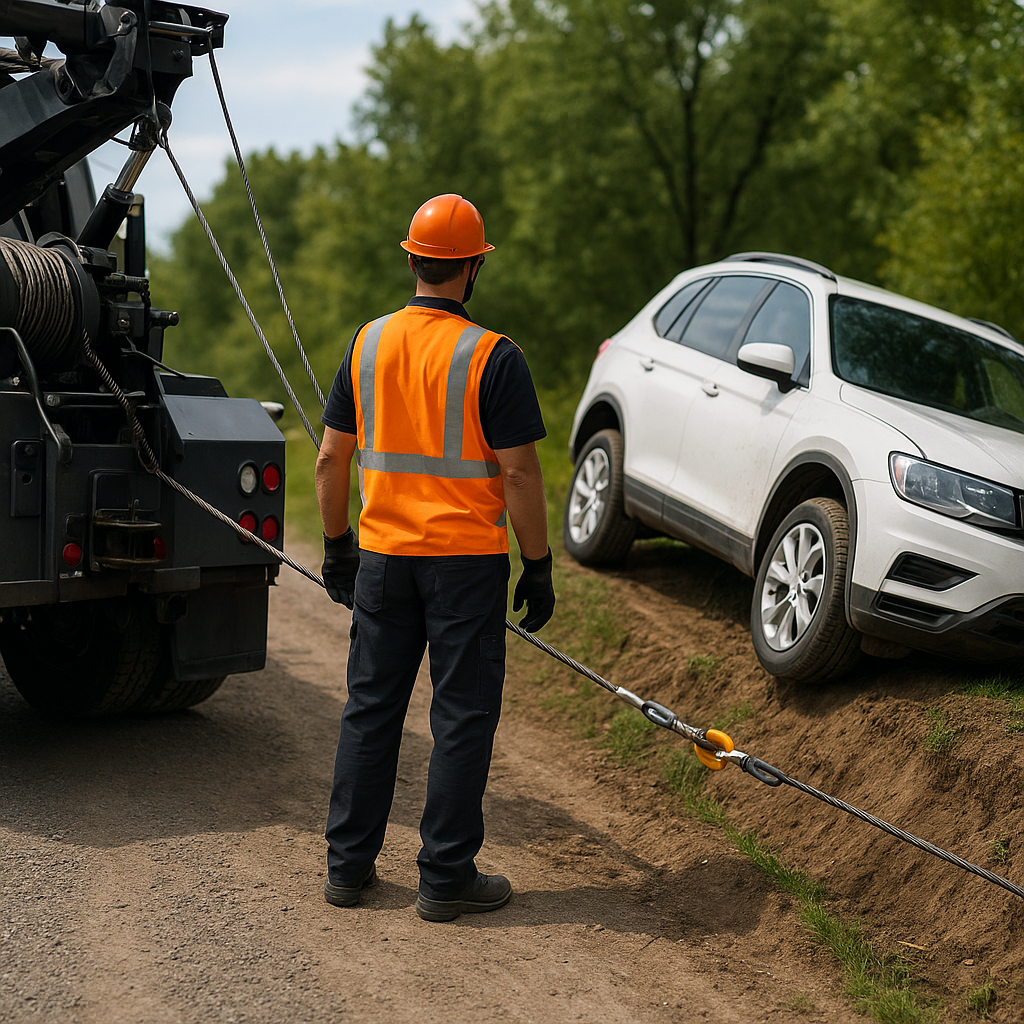
You pulled onto the shoulder to take a phone call and the right wheels sank. You cut a corner in a soft yard after a week of rain. You slid into the ditch on a curve near New Hill. The car is fine; it just is not going anywhere under its own power. This is a winch-out, one of the most common tow calls around Cary, and it is a different job from a tow. Here is what it involves, why spinning your wheels makes it worse, how to stay safe while it happens, and how it is priced.
What a winch-out is
A winch-out (or recovery) uses the winch on a tow truck to pull a stuck vehicle back onto firm ground. Once it is on solid pavement, it can often be driven away with no tow at all. If it was damaged going in, it gets loaded and towed from there. The winch line runs from the truck to a proper recovery point on your vehicle, and the operator controls the pull slowly and steadily so nothing bends.
Common ways Cary drivers get stuck
- Soft shoulders. After rain, the grass shoulder along US-1, NC-55 and the two-lane roads west of Cary is mud under a green crust. Two wheels drop in, the car high-centers on the pavement edge, and the drive wheels spin in air.
- Ditches. Roads around Green Level, New Hill, Holly Springs and southern Apex have deep drainage ditches right at the shoulder. A moment of distraction on a curve, or a slide in the rain, and the car is nose-down.
- Yards and construction sites. Turning around on a soft lawn, backing a trailer onto a new-construction lot, or parking on grass for an event at Koka Booth or Bond Park after a wet week.
- Snow and ice. Rare, but when it comes, the hills in older Cary neighborhoods and the ramp at Cary Parkway and I-40 fill with cars that could not make the grade.
- Parking mishaps. A wheel off the edge of a parking deck ramp, a car hung up on a curb or a parking block, a low car beached on a speed bump.
Stop spinning the wheels
The instinct to floor it is the most expensive instinct in the situation. Spinning tires dig the car deeper, pack mud into the tread so it has no grip left, throw rocks and mud into the wheel wells and brakes, and can overheat an automatic transmission in under a minute. If one or two gentle attempts (rocking between drive and reverse with light throttle) do not move the car, stop. Every additional attempt makes the recovery longer and more likely to involve damage.
Traction control makes this worse in some cars by cutting power when it detects spin. In others it helps. Either way, if you are not out in two tries, you are not getting out without help.
Before you call
- Turn on your hazards. If you are on a road, stay visible.
- Get everyone out of the car only if it is safe and the car is stable. A car nose-down in a ditch can shift.
- Look at how the car is sitting: which wheels are off the ground, whether the underside is resting on anything, whether there is water in the ditch.
- Note whether anything is leaking. A puddle under the car after a ditch means the oil pan or a coolant line may be cracked, and the car should not be driven even after it is out.
What the operator does
- Assesses the situation. How far off the road, what the ground is like, what the car is resting on, and where the safe recovery points are. Modern cars have specific tow points, often behind a small cover in the bumper with a threaded eye that screws in. Pulling from the wrong spot bends things.
- Positions the truck on firm ground, in line with the pull, with the light bar protecting the scene from traffic.
- Rigs the line to the recovery point, sometimes using a snatch block to change the angle of the pull or double the force.
- Pulls slowly. A steady winch pull moves the car a few inches at a time. Yanking is how bumpers come off.
- Checks the car once it is on pavement. If it drives, you drive away. If not, it goes on the flatbed.
Stay well clear of the winch line during the pull. A line under load stores a lot of energy, and the operator will ask you to stand back for a reason.
Will it damage the car?
Done properly, no. Using the manufacturer’s recovery points, pulling in line with the direction the car went in, and going slowly are what prevent damage. The damage people see after a ditch recovery almost always happened on the way in, not on the way out: a cracked bumper cover from the ditch bank, a bent tie rod from hitting the far side, a torn undertray. The operator will point out anything they see so you know what to tell your shop.
How winch-outs are priced
Recovery work is billed separately from towing, usually based on time and difficulty, because a two-minute pull off a soft shoulder and a forty-minute recovery from a wet ditch with the car on its side are very different jobs. When you call, describe the situation as accurately as you can and the dispatcher will give you a price or a range before the truck rolls. If the car needs to be towed afterward, that is priced as a tow. The towing cost guide explains more.
Preventing it
- After heavy rain, do not pull onto grass shoulders. Use a driveway or a paved lot for phone calls.
- On two-lane roads west of town, slow down on curves, especially at night and in rain. The ditches are close and deep.
- If you must turn around on soft ground, keep moving. Stopping is when you sink.
- Carry a small folding shovel and a set of traction mats if you drive rural roads regularly.
The featured provider, WTF Towing, handles winch-outs and recoveries throughout Cary, Apex, Morrisville, Holly Springs, New Hill and RTP, 24 hours a day. Call (919) 230-4498, or see winching service.
Frequently asked questions
Do I need a tow after a winch-out? Often not. If the car drives and nothing is leaking, you are on your way.
Can a friend with a pickup pull me out? People try. Chains snap, bumpers tear off, and the pickup sometimes ends up stuck too. A winch with a controlled pull is the safer tool.
What if my car is on its side or roof? That is a recovery job requiring more equipment and care. Stay away from the car and call; tell the dispatcher exactly how it is sitting.
Will they recover a car from private property? Yes, with the owner’s permission to be on the property.
WTF Towing – 24/7 towing and roadside help in Cary, NC.
Answered 24/7 · WTF Towing in Cary