
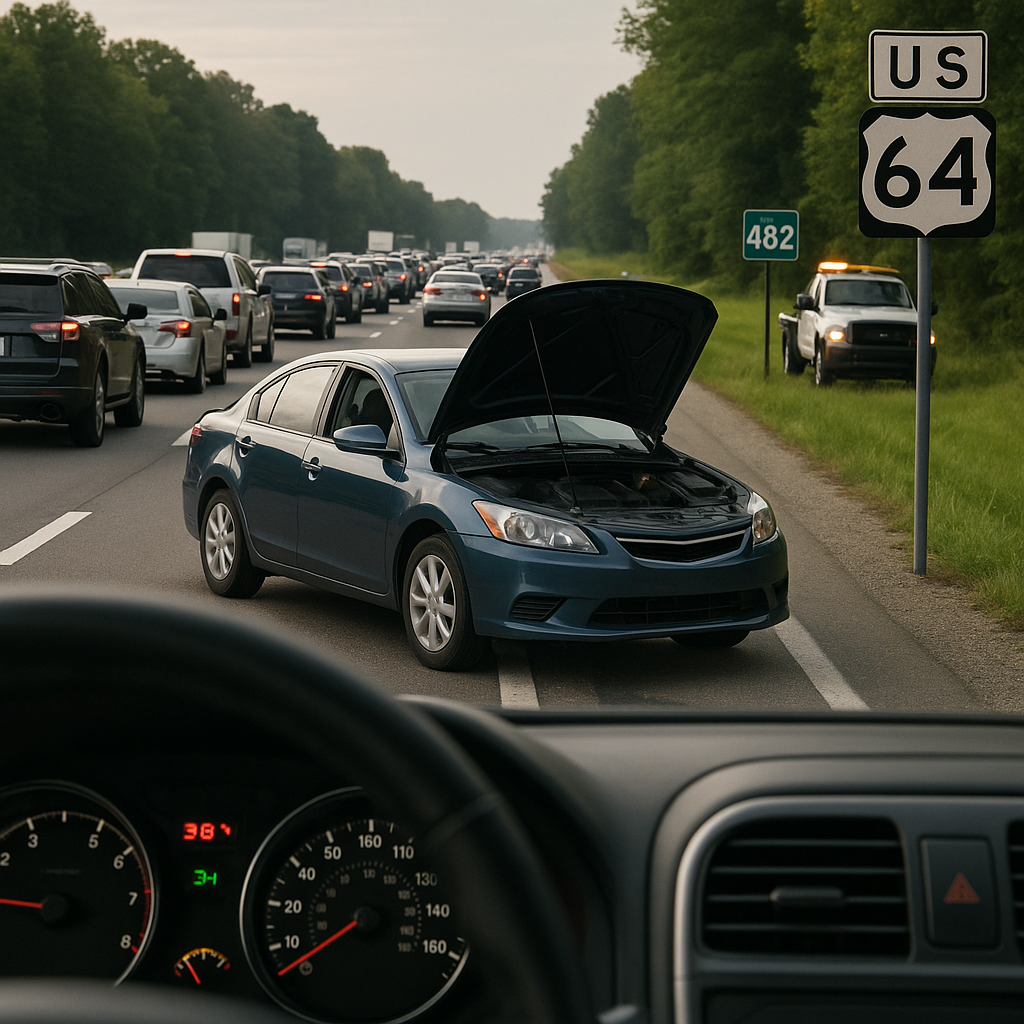
The Cary commute is a set of pinch points, and a breakdown at any of them at 7:45 a.m. or 5:15 p.m. is a different experience from the same breakdown at noon. There is no room to pull over, everyone behind you is late, and the tow truck coming to help is stuck in the same traffic. This guide covers the specific corridors Cary drivers use to reach RTP, Raleigh and Durham, what goes wrong on each, how to handle a rush-hour breakdown safely, and how to stop your car from being the reason everyone else is late.
US-64 and US-1: the Apex and Cary spine
US-1 / US-64 carries Apex, Holly Springs and southern Cary to I-40 and back. Mornings are heavy northbound from the Apex Peakway through the Cary Parkway and Walnut Street exits; evenings reverse it. The problem spots: the merge at Tryon Road, the long grade approaching Walnut Street where older cars overheat in the crawl, and the Cary Towne Boulevard interchange where stop-and-go traffic kills weak batteries and alternators. The shoulders are decent on the main line but narrow on the ramps. If you feel the car faltering, get onto the shoulder on the main line rather than trying to make a ramp.
NC-54 and Davis Drive: the RTP run
Morning traffic from Cary to RTP funnels onto NC-54 (Chapel Hill Road) and Davis Drive, and both are two-lane roads for long stretches with turn lanes, school zones and few shoulders. A stalled car here blocks a lane outright. If the car dies, put the hazards on and, if you have help and it is safe, push it into a turn lane, a driveway or a side street. Davis Drive north of Morrisville-Carpenter Road and the stretch of NC-54 near the Morrisville town line are the worst places to stop; the nearest parking lot is worth an extra hundred yards of coasting.
I-40 through Cary
The eastbound morning crawl from the I-540 split through Harrison Avenue to Wade Avenue, and the westbound evening version, are where more Cary commuter breakdowns happen than anywhere else. The shoulders are wide, which is the good news. The bad news is that a tow truck coming to you at 5:15 p.m. is in the same traffic. Call the moment you are stopped; do not spend fifteen minutes trying to restart the car first. See the full I-40 breakdown guide.
Into Raleigh: Wade Avenue, I-440, Western Boulevard and Capital Boulevard
Cary drivers headed downtown or to the state government complex mostly use Wade Avenue to I-440 or Western Boulevard. Wade Avenue’s left-side merge and the I-440 curves near the fairgrounds are tight, and the shoulders on the Beltline shrink to almost nothing in places. Capital Boulevard on the north side is a different animal: long lights, heavy trucks, and drivers who treat the center turn lane as a passing lane. On the Beltline, the guidance is the same as any interstate: shoulder, hazards, stay in the car. On Western or Capital, get into a lot.
Event nights: PNC Arena, the fairgrounds and campus games
A Hurricanes game or a concert at PNC Arena puts thousands of cars on Wade Avenue, Edwards Mill Road and Trinity Road at the same time, and the lots empty in a single slow wave. The cars that die are the ones that tailgated with the radio on for three hours, the ones that were already low on fuel and idled for 40 minutes leaving the lot, and the ones with a battery that was on its last legs. The State Fair in October does the same thing to the same roads for eleven days. Football weekends in Chapel Hill and Durham push the same problem onto I-40 West. The fixes are boring and they work: check the battery in the fall, do not sit with the accessories on, fill the tank before the event, and if the car dies in the lot, call while you are still parked rather than after you have been pushed into a lane.
Handling a rush-hour breakdown
- Use your momentum. The moment the car falters, signal and move right. Do not wait for it to stop in the lane.
- Aim for a lot, a side street or a wide shoulder, in that order. A ramp shoulder is better than a lane; a parking lot is better than either.
- Hazards on, and stay in the car if you are on a highway or a busy arterial. Getting out to look under the hood in rush-hour traffic on NC-54 is how people get hit.
- Call right away. Give the road, direction, nearest cross street or exit, and say it is rush hour so dispatch can plan the route.
- If the car is in a live lane and will roll, and you have help, push it to the shoulder with someone steering. If you are alone, do not try; call 911 for traffic control and wait.
- Tell work you will be late. Then stop worrying about it. A breakdown handled calmly costs an hour; one handled badly costs a lot more.
Why the ETA is longer at rush hour, and what helps
A truck that reaches you in fifteen minutes at 2 p.m. may take 35 at 5:15 p.m., because Davis Drive and I-40 are stopped for everyone. A precise location, a description of your car, and answering your phone when the driver calls all shave time off. So does telling the dispatcher whether you are in a lane or safely off the road; a car blocking a lane gets prioritized. Read more in how long does a tow truck take in Cary.
Being commute-proof
- Battery: load-test it every fall after three years. Batteries fail on cold mornings in the middle of the morning commute.
- Cooling: if the temperature gauge moves in traffic, fix it before summer. The US-1 crawl and the I-40 westbound crawl are where cooling fans get found out.
- Fuel: a quarter tank minimum. Detours around a wreck on I-40 can double your miles.
- Tires: pressure monthly. The construction zones on I-540 and NC-540 south of Apex are full of debris.
- Save the number. (919) 230-4498, under “Tow.” You do not want to be searching for a towing company with 6% battery on the shoulder of I-40.
The featured provider, WTF Towing, works every one of these corridors every weekday: US-1, US-64, NC-54, Davis Drive, I-40, I-540, Wade Avenue and the roads into RTP, from Cary, Apex, Morrisville and Holly Springs. Dispatch answers 24 hours a day.
Frequently asked questions
Should I call 911 if I break down in a lane at rush hour? Yes, if the car cannot be moved and is blocking traffic. Police can protect the scene until the tow arrives. Call for your own tow too, so you choose where the car goes.
Can I be towed to work and deal with it later? Yes. You choose the destination, whether that is an office lot in RTP or your mechanic.
Is it faster to call a local company or my roadside program at rush hour? Calling a local company directly removes the call-center step, which matters most when every minute of traffic counts.
My car died in the RTP office lot at 6 p.m. Which service do I need? Probably a jump start. Tell the dispatcher what happened and they will send the right thing.
WTF Towing – 24/7 towing and roadside help in Cary, NC.
Answered 24/7 · WTF Towing in Cary