
“How long?” is the first question everyone asks and the one most towing websites answer with a number that was never true. The honest answer is that it depends on where you are, what time it is, what the weather is doing and where the nearest truck happens to be. This guide explains what really drives tow truck arrival times around Cary, what changes at night and on weekends, why a call center can quietly double your wait, and what you can do to shorten it.
What actually determines your wait
- Where the nearest available truck is. Not where the company’s office is. A company can be “in Cary” and have every truck out on jobs in Raleigh. A dispatcher who can see the trucks gives you a real number; a call center guesses.
- Time of day. A 2 p.m. weekday call is quick. A 5:30 p.m. call, when I-40 westbound is stopped from Wade Avenue to Harrison, is not, because the truck is stuck in the same traffic you are.
- Weather. The first rain after a dry spell, the first freezing morning of the year, and any storm produce a surge of calls all at once. Everyone is waiting longer, everywhere.
- What kind of truck you need. If your car is all-wheel drive, lowered or electric, it needs a flatbed. If the closest truck is a wheel-lift, you wait for the flatbed or accept the wrong equipment. We send the right one.
- How clearly you describe your location. “Somewhere on 540 near the airport” can cost a driver ten minutes of searching. “540 East, just past the Aviation Parkway exit, mile marker 3.6” gets the truck to you directly.
Daytime on weekdays
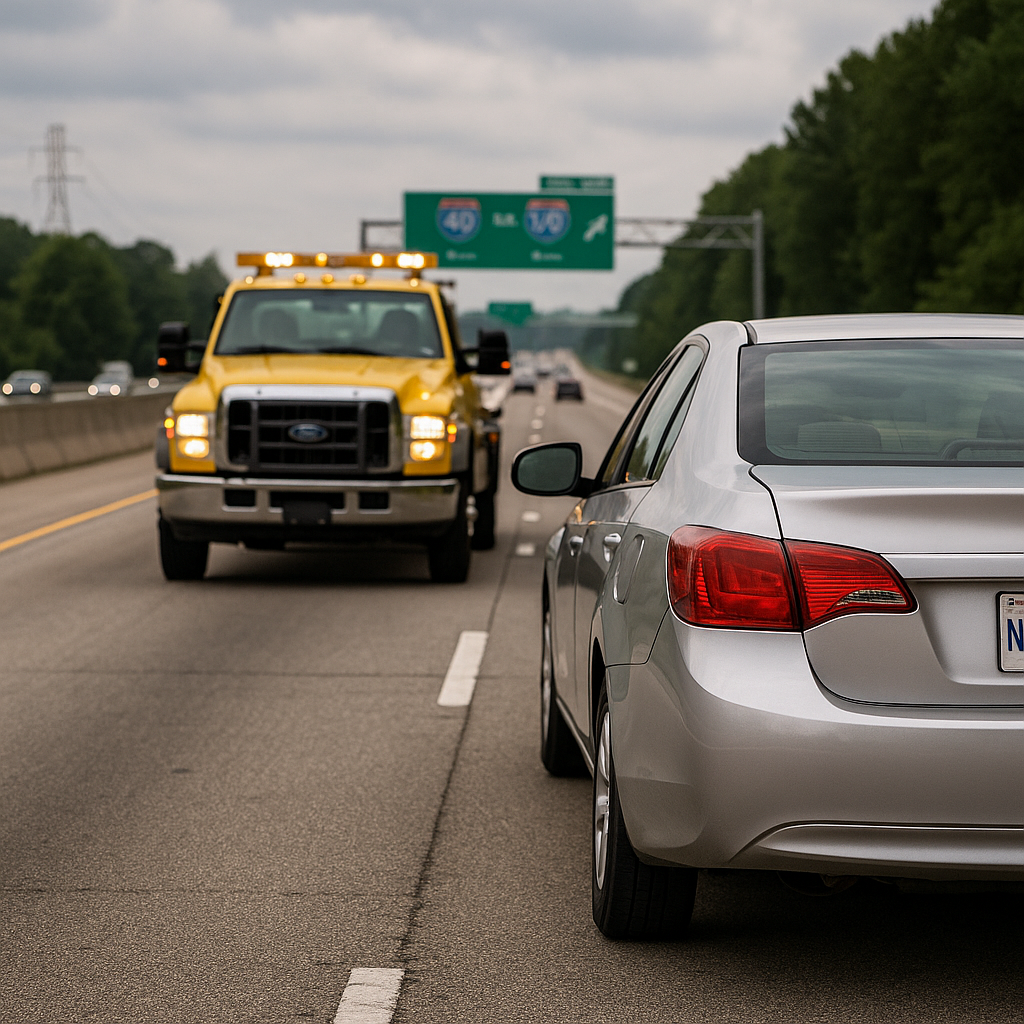
Midday calls in Cary, Apex and Morrisville are the fastest: traffic is light, trucks are cycling through routine jobs, and the roads to you are clear. The exceptions are the morning and evening rushes. Between roughly 7 and 9 a.m., anything involving I-40 eastbound, US-1 northbound or Davis Drive toward RTP is slow going for everyone. Between 4:30 and 6:30 p.m., reverse it. If you break down in rush hour, expect the ETA to reflect that, and know that the driver is not sitting still; the road simply is not moving.
Nights: what a 2 a.m. call looks like
Night calls are different in a few ways.
- Traffic is not the problem. A truck can cross Cary in ten minutes at 2 a.m.
- Fewer trucks are on the road. Companies run lighter overnight, so if two calls come in at once, one waits. Ask the dispatcher where you are in line.
- Finding you is harder. Turn on your interior light, keep the hazards going, and if you are in a parking deck, give the level and a pillar number.
- Your destination may be closed. Most shops are locked at night. The driver can leave the car in the shop’s lot and you drop the keys, or take it home and you deal with the shop in the morning. Decide before the truck arrives.
Late-night calls around RTP and Cary tend to be shift workers leaving the research campuses, people coming home from RDU on a delayed flight, and restaurant staff finishing up in downtown Cary. WTF Towing dispatch answers all night, every night, at (919) 230-4498.
Weekends and event days
Saturday afternoons are busier than people expect. Everyone is out, parking lots are full, and shopping-center lockouts and dead batteries spike. Add a rainy Saturday and the calls stack up. US-1 between Cary and Apex is heavy most of Saturday, and Walnut Street around Crossroads and Cary Towne Boulevard crawl from late morning on.
Event nights add another layer. A concert or game at PNC Arena, a big game at Kenan Stadium, or a festival in downtown Cary pulls trucks toward the venue and clogs the roads around it. If you are headed to an event, the smartest thing you can do is make sure your car is not the one that dies in the venue lot at 11 p.m.: check the battery in the fall, do not sit with the radio on for two hours of tailgating, and keep the tank above a quarter.
Why a call center can double your wait
When you call a roadside program, the person you talk to is often hundreds of miles away. They take your information, search for a contracted provider in the area, send the job electronically, and wait for someone to accept it. If no one accepts in a few minutes, it goes to the next provider. Only then does a truck start rolling, often from farther away than the closest company, and the ETA you were quoted was generated by software that has never seen I-40 at 5:15. Calling a local company directly removes all of that. You are talking to the person who is deciding which truck to send.
How to shorten your wait
- Call as soon as you are safely stopped. Do not spend twenty minutes trying to restart a car that made a loud noise.
- Give a precise location. Road, direction, exit or mile marker, or a business name and which side of the lot.
- Mention anything that changes the truck. AWD, lowered, EV, a trailer, a dually, a car in a tight parking deck.
- Answer your phone. The driver may call for a better description. Unknown numbers are your friend for the next half hour.
- Be ready when the truck arrives. Valuables out, destination decided, keys in hand.
- Ask for the honest number. A good dispatcher would rather tell you 40 minutes than promise 15 and miss it.
What you can do while you wait
On a highway shoulder, stay in the car with your belt on. In a lot, stay near the car and off the pavement. Keep hazards on. If it is hot, run the engine briefly for air conditioning if the car will run; if it is cold, layer up and keep a window cracked if you run the heater. Text someone where you are and who is coming. And if the wait goes past what you were quoted, call back. Dispatch can tell you exactly where the truck is.
Frequently asked questions
So how long will it take? Call and ask. You will get a real estimate based on where the closest truck is right now, not a marketing number.
Is it faster to call you or my insurance? Calling us directly is almost always faster, because there is no middle step. You can often submit the receipt for reimbursement afterward; check your policy.
Do you charge more at night or on weekends? Ask the dispatcher for the price when you call. You will know the number before a truck is sent.
What if I need to cancel? Call as soon as you know. If a truck is already on the way, there may be a trip charge; the dispatcher will tell you.
Do you cover RTP and the airport? Yes: Cary, Apex, Morrisville, Holly Springs, New Hill, RTP and RDU, along with I-40, I-540, US-1 and US-64 in between.
WTF Towing – 24/7 towing and roadside help in Cary, NC.
Answered 24/7 · WTF Towing in Cary