
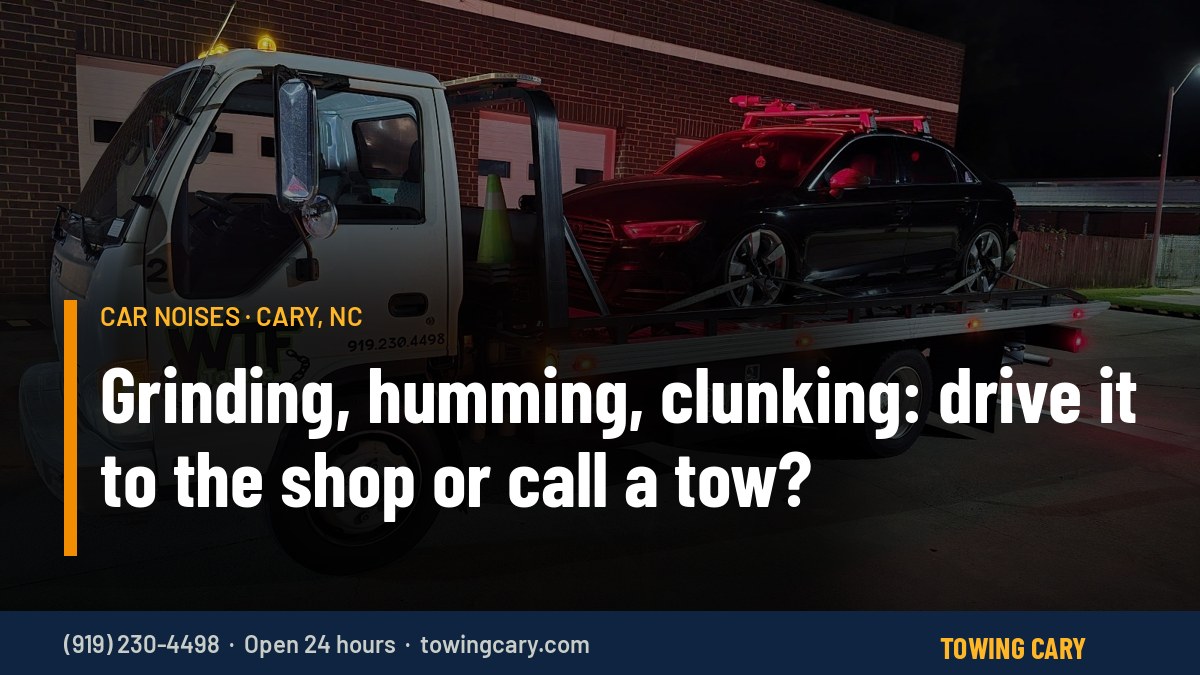
Grinding, Humming or Clunking: Drive It or Tow It?
Which car noises mean stop now and tow, which mean drive gently to the shop, and which are harmless, with the heat test, the smell test and what to tell the dispatcher.
On this page
A new noise is the car asking a question: can I keep going, or do I need a truck? Most drivers answer it by turning up the radio for a week, and some of those weeks end on the shoulder of I-40 with a repair bill several times what it would have been on day one. Other noises are harmless and not worth a tow. This guide sorts the common ones Cary drivers hear into three bins: drive it to the shop today, drive it gently and only to the shop, and stop now and call for a tow. It is written for ordinary cars on ordinary Cary roads; when in doubt, the tow is cheaper than the gamble.
Stuck right now? WTF Towing, this site’s featured 24/7 provider, answers around the clock: 📞 (919) 230-4498
How to listen
Before deciding, gather three facts. When does it happen: at idle, only while moving, only when turning, only when braking, only over bumps? Where does it seem to come from: a wheel, under the hood, under the floor? Does it change with speed, with engine revs, or with steering? A noise that follows wheel speed is suspension, brakes, tires or bearings. A noise that follows engine revs is the engine or its belts. Fifteen seconds of attention narrows it a lot.
Stop now and call for a tow
- A loud bang or clunk followed by loss of power, or a sudden rattle from the engine. Something inside has let go. Every rotation after that does more damage. Coast to the shoulder, shut it off, do not restart.
- Metal-on-metal grinding when braking, with a pedal that feels different. Pads are gone and the caliper is cutting the rotor; brakes can fail outright. Stop in the nearest safe spot.
- A loud hum or growl from a wheel that has become a roar, especially with heat or smoke. A wheel bearing that is failing can seize or let the wheel wobble. Do not drive it on I-540.
- Clunking from the front end that comes with loose or vague steering. Tie rod or ball joint. If it separates, you lose steering of that wheel. This is a tow, not a drive.
- A squeal that stops when the engine dies, plus a battery or temperature light. The serpentine belt is slipping or gone; you are about to lose the alternator, water pump and power steering at once. A few minutes of driving will overheat the engine.
- Knocking that gets faster with revs, with the oil light on. Low oil pressure. Shut it off immediately; this is how engines are destroyed in one commute.
- Grinding or whining from the transmission with slipping or no drive. Continuing to drive turns a repair into a replacement.
In every one of these, the move is the same: get out of traffic, shut the engine off, and call. What to do when you break down on I-40, I-540 or US-1 covers the shoulder part; the dispatcher handles the rest.
Drive it, gently, straight to the shop
- A high-pitched squeal when braking, no change in pedal feel. The brake wear indicator. You have days, not weeks. Book it.
- A low hum from one corner that rises with speed and changes when you swerve. Early wheel bearing. Short trips on surface streets to the shop are usually fine; a highway run to the beach is not.
- Clunks over bumps, steering still tight. Sway-bar links or worn bushings. Annoying, not dangerous today; get it inspected soon.
- A rhythmic thump that matches wheel speed. Often a tire with a bulge, a separated belt or a lump of mud. Pull over and look; a bulge means slow and straight to a tire shop, nothing faster. Tires and what a bulge means.
- A chirp or squeal on cold start that fades. A glazed belt or a weak tensioner. Fix it before it becomes the stranded-with-no-charging version above.
- A hiss or whistle under the hood with a rough idle. A vacuum leak. Drivable, but it will throw a check-engine light and hurt mileage.
Probably fine, but get it looked at
- A rattle from the dash or doors on Cary’s rougher streets. Trim.
- Ticking from the engine on cold mornings that quiets as it warms. Normal on many engines; mention it at the next oil change.
- A faint whir that changes with the fan speed. Blower motor bearing or a leaf in the fan.
- Exhaust rattle at idle. A loose heat shield. Loud, cheap, harmless.
The heat test and the smell test
Two quick checks after a drive with a new noise. Hold the back of your hand near each wheel (do not touch): one wheel noticeably hotter than the others points to a dragging brake or a bearing on its way out. Then smell: hot brakes have a sharp, acrid smell; a sweet smell is coolant; burning rubber is a belt or a tire rubbing; burnt toast is an electrical problem. Any of these plus a noise moves the car up a bin.
Why the tow is usually the cheap choice
A local tow across Cary to your mechanic is a fixed, modest cost, quoted before the truck rolls. The repairs that driving-it-anyway produces are not: a bearing that takes the hub and the axle with it, a rotor cut through, a belt failure that cooks a head gasket, a transmission that slips its way to a rebuild. The towing cost guide explains how the tow is priced, and choosing a repair shop after a tow covers getting the car to the right place with the right notes on the dash.
What to tell the dispatcher
- Where you are and whether the car is out of traffic.
- The noise, in plain words: “grinding from the front left when I brake,” “loud bang then no power.”
- Whether the car rolls and steers. A car with a seized wheel needs dollies on the flatbed.
- Year, make, model, and AWD or EV. See which truck your car needs.
- Where it should go.
In Cary, Apex, Morrisville, Holly Springs and RTP, the featured 24/7 provider is WTF Towing at (919) 230-4498; the dispatcher quotes the price before a truck is sent.
Frequently asked questions
Is it safe to drive to the shop with a grinding brake?
If the pedal feels normal and the shop is a few miles of surface streets away, usually yes, gently. If the pedal is soft, pulsing or sinking, no: tow it.
My car makes a humming noise only on I-540. Bearing or tires?
Swerve gently side to side at speed when it is safe. If the hum changes with the swerve, suspect a bearing; if it stays the same, suspect the tires. Either way, have it checked before a long trip.
The noise went away. Am I good?
Noises that come and go are still noises. Bearings, belts and brakes all have quiet days before they fail. Mention it to your mechanic.
Will a tow truck take a car that will not roll?
Yes. Say so when you call; the driver brings dollies and winches it onto the flatbed.
WTF Towing – 24/7 towing and roadside help in Cary, NC.
Answered 24/7 · WTF Towing in Cary
Related guides
Seasonal Car Maintenance Checklist for Cary and Triangle Drivers
Season-by-season car maintenance checklist for Cary and Triangle drivers, plus which dashboard warning lights mean stop now and what brake trouble feels like.
Overheating in Cary’s Summer Heat: Steps That Save Your Engine
Car overheating in Cary's summer traffic? Early warning signs, exactly what to do when the gauge climbs, what never to do, common causes, and when to drive versus tow.
Thanksgiving Week on I-40 Out of Cary: Breakdown-Proofing the Trip
Five checks the weekend before, when to leave Cary, what I-40, US-1 and US-64 look like Thanksgiving week, and what to do if the car quits near home or far away.