
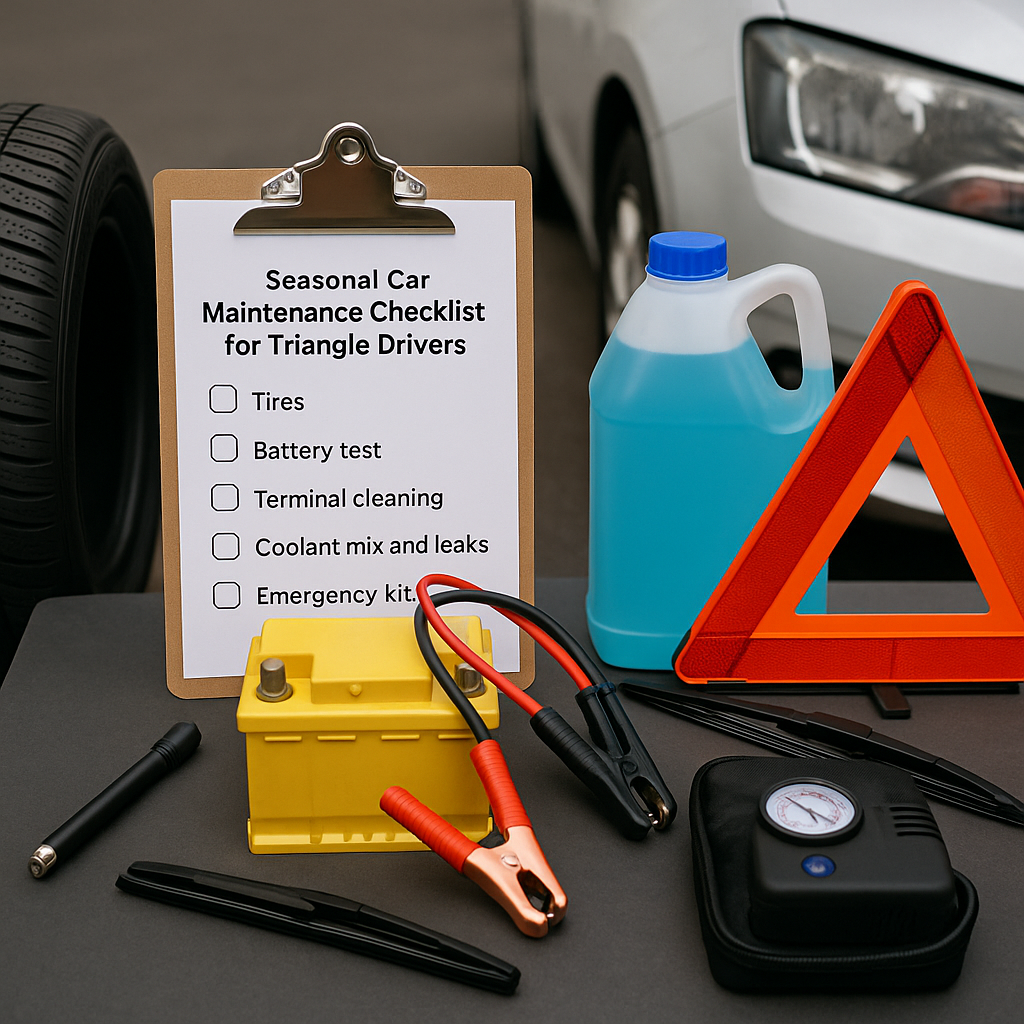
Cary gets four real seasons, and each one finds a different weakness in your car. Summer heat kills batteries and exposes cooling systems. The first cold snap in November finishes off the batteries the heat weakened. Winter’s occasional ice storm reveals bald tires and dead wiper blades. Spring pollen clogs cabin filters and the first big rains find worn tread. This checklist is organized by season for Triangle drivers, with the items that actually generate tow calls at the top of each list, plus a section on which warning lights mean “pull over now” and which mean “get it looked at this week.”
Spring (March to May)
- Tires. Winter potholes bend wheels and bulge sidewalls. Look at every tire for bulges and check pressure; the swing from cold mornings to warm afternoons throws the TPMS light on and off.
- Wiper blades. Spring brings the heaviest rains. Replace blades that streak or chatter; they are cheap and it takes five minutes.
- Cabin air filter. Triangle pollen season is famous for a reason. A clogged cabin filter makes the air conditioning weak and musty just as you need it.
- Alignment. If the car pulls or the steering wheel is off-center after a winter of potholes on Cary Parkway, get it aligned before it eats a set of tires.
- Brakes. Listen for squeal or grinding. Spring is a good time for a brake inspection before summer road trips.
- Air conditioning. Run it on the first warm day. Weak cooling now means a failed compressor in July, when every shop is booked.
Summer (June to September)
- Battery. Heat is what actually kills batteries; cold just reveals it. Have a battery over three years old load-tested. Clean the terminals.
- Cooling system. Coolant level, hose condition, fan operation, radiator fins clear of debris. This is the season for the overheating guide.
- Tires. Hot pavement plus high speed plus low pressure equals blowouts. Check pressure monthly when the tires are cold.
- Belts. Heat hardens rubber. Look for cracks and glazing on the serpentine belt.
- Oil. High temperatures thin oil and stress it. Do not stretch the change interval in summer.
- Before road trips: the holiday travel checklist covers the pre-trip inspection.
Fall (October to November)
- Battery again. The first morning in the 30s is when every marginal battery in Cary fails at once. If you skipped the summer test, do it now. This is the single most valuable item on the whole list.
- Heater and defroster. Test them before you need them. A heater that does not get hot can also signal low coolant or a stuck thermostat.
- Lights. Shorter days mean more driving in the dark. Check every bulb, and clean yellowed headlight lenses; they cut your light output dramatically.
- Tires. Wet leaves are as slick as ice. Tread depth above 4/32″ matters on the first rainy fall commute.
- Wipers and washer fluid. Switch to a fluid that will not freeze.
- Emergency kit. Blanket, flashlight, jump pack (charged), phone charger, water.
Winter (December to February)
- Battery, one more time. A battery loses a large share of its cranking power at freezing temperatures. If the car cranks slowly on a cold morning, replace the battery before it strands you.
- Tires. Pressure drops about 1 psi per 10°F. Top up. All-season tires are fine for Cary’s typical winter; the real hazard is the once-a-year ice, when nothing short of staying home works.
- Coolant. Make sure the mix protects to well below freezing. A shop can test it in seconds.
- Doors and locks. Frozen doors and dead batteries are the winter-morning double feature; the winter morning guide covers both.
- Fuel. Keep the tank above half in cold snaps. Condensation in a near-empty tank can freeze fuel lines on the rare very cold night.
- Ice storm rules. If there is ice, do not drive. Cary has few plows, the hills in older neighborhoods are treacherous, and the ramps at I-40 and Cary Parkway fill with cars that could not make the grade. Wait for the sun.
Warning lights: stop now or this week?
Dashboard lights are the car telling you what it needs. Some are urgent; some are not. The colors are the first clue: red means stop, amber means soon.
Pull over and shut off the engine now
- Oil pressure light (a red oil can). Not the oil level; the pressure. Driving with this on for even a minute can destroy the engine.
- Temperature warning (red thermometer). Overheating. See above.
- Charging system light (red battery). The alternator has failed. You have a few minutes of battery power before everything shuts down; get somewhere safe.
- Brake warning light (red, with the parking brake released). Low fluid or a hydraulic failure. Test the pedal carefully at low speed.
- Flashing check-engine light. A steady light is “get it checked.” A flashing one means an active misfire that can destroy the catalytic converter in minutes.
Get it looked at soon
- Steady check-engine light. Could be anything from a loose gas cap to a failing sensor. Have the code read (most parts stores do it free) within a few days.
- Tire pressure light. Check the tires at the next stop. If one is visibly low, do not drive on it.
- ABS or traction control light. The brakes work, but the anti-lock function may not. Drive gently and have it checked.
- Maintenance reminder. An oil change is due.
Brake trouble: what it feels like
Brakes rarely fail all at once, but they do warn you. A high-pitched squeal is the wear indicator telling you the pads are nearly done. A grinding noise means metal on metal, and every stop is damaging the rotors. A soft or sinking pedal means air or a leak in the hydraulic system; a pulsing pedal means warped rotors. A car that pulls to one side under braking has a sticking caliper. Squeal is a “this month” problem. Grinding, a soft pedal or a pull is a “this week, and drive gently until then” problem. If the pedal ever goes to the floor, pull over using the parking brake gently and call for a tow; it is not safe to drive.
When maintenance did not happen in time
If a warning light or a noise turns into a car that should not be driven, do not push it to the shop. A tow across Cary costs less than the repair you cause by driving a car with no oil pressure or a grinding wheel bearing. WTF Towing will take it to your mechanic anywhere in Cary, Apex, Morrisville, Holly Springs or RTP. Call (919) 230-4498.
Frequently asked questions
How often should I really change the oil? Follow the manual’s interval for your driving type. Cary’s short-trip, stop-and-go commuting counts as “severe service” for most manufacturers, which shortens the interval.
Is a battery test really free? At most auto parts stores, yes, and it takes five minutes in the parking lot.
My check-engine light has been on for months and the car runs fine. Is that OK? It is hiding whatever comes next. A light that is always on cannot warn you about a new problem. Get the code read.
What single thing prevents the most breakdowns? Replacing the battery at the first slow crank instead of waiting for it to die.
WTF Towing – 24/7 towing and roadside help in Cary, NC.
Answered 24/7 · WTF Towing in Cary