
Wet Leaves and First Frost on Cary Parkway and Tryon Road: Fall Driving in Cary
Why wet leaves grip like ice, where it happens on Cary Parkway, Tryon Road and Maynard, how to handle the first frost on bridges, and what to do if you slide off.
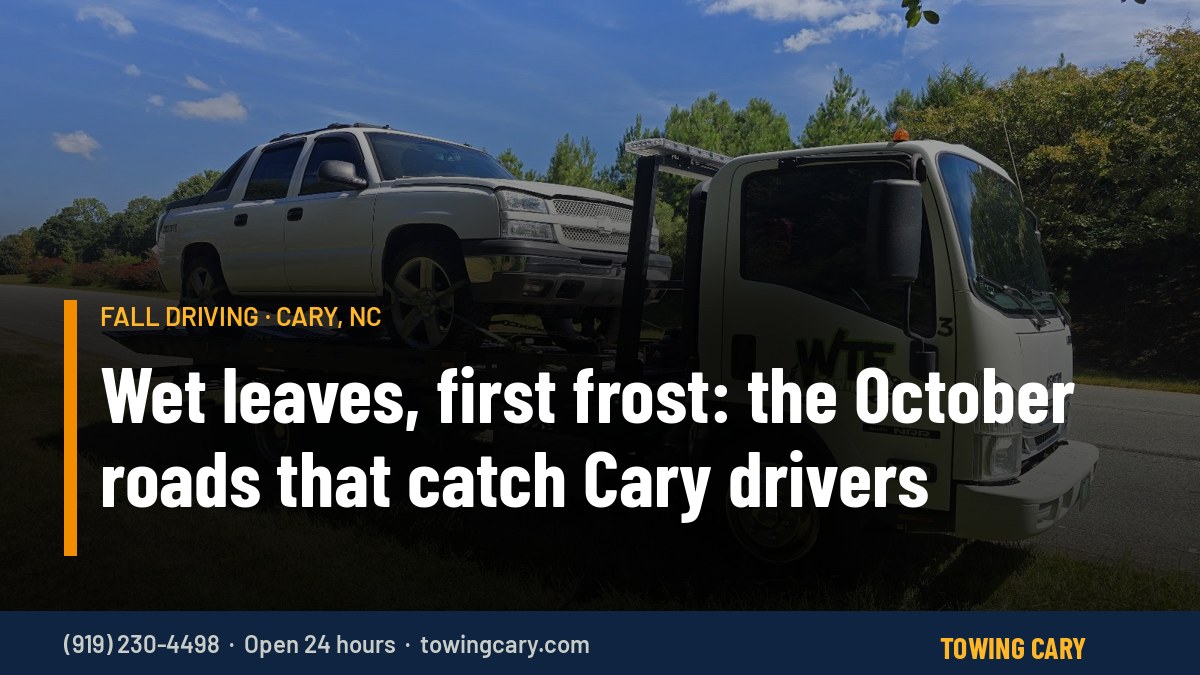
On this page
October in Cary looks harmless: dry pavement, bright afternoons, a few leaves on the road. Then the first cool, damp morning arrives, the oaks along Cary Parkway and Tryon Road drop a week’s worth of leaves overnight, and the roads turn as slick as the first rain of summer. Add the first frost of the season on the bridges and shaded curves, and the tow calls come in bunches between 6:30 and 8:30 a.m. Here is what changes on Cary’s roads in October and November, where the trouble spots are, how to drive them, and what to do if your car lets you down on a cold morning.
Stuck right now? WTF Towing, this site’s featured 24/7 provider, answers around the clock: 📞 (919) 230-4498
Why wet leaves are as slick as ice
A layer of wet leaves does two things at once. The leaves themselves are smooth and waxy, so tires slide across them instead of gripping pavement. And they trap a film of water underneath that never dries, even hours after the rain stops. The result is a surface with grip somewhere between wet asphalt and glare ice, concentrated exactly where you need grip most: on curves, on hills, and in the braking zones before intersections where leaves pile up against the curb. Tires that were marginal all summer (below 4/32″ of tread, or underinflated) give up first.
Where it happens around Cary
- Cary Parkway, especially the tree-lined stretches between High House Road and Kildaire Farm Road and the curves near the creeks. Leaves pile in the right lane and the turn lanes.
- Tryon Road between Kildaire Farm and Walnut Street, under heavy tree cover with a long downhill grade toward the US-1 interchange.
- Maynard Road, the whole loop, with shaded sections that stay wet all day.
- Chapel Hill Road (NC-54) from downtown Cary toward Morrisville, two lanes with a lot of mature trees.
- Older neighborhoods off Kildaire Farm Road and around downtown, where the streets are narrow and the oaks are big.
- Greenway crossings and cul-de-sacs, where leaf piles sit against curbs for weeks.
First frost: bridges, ramps and shade
Cary’s first frost usually arrives in late October or early November, and it does not fall evenly. Bridges and overpasses freeze first because cold air reaches them from below. The ramps at Cary Parkway and I-40, the US-1 overpasses and the bridges on I-540 near the airport can carry a skin of frost while the roads leading to them are merely damp. Shaded curves on Tryon Road and Davis Drive hold frost an hour longer than the sunny stretches. If the thermometer in your car reads anywhere near 35°F on a damp morning, treat every bridge and every shaded curve as if it might be slick.
Driving the fall roads
- Slow down before the leaves, not on them. Brake on clean pavement, then roll across the leaf patch at a steady speed with your foot off both pedals.
- Double the following distance. Wet leaves add car lengths to your stopping distance.
- Avoid the curb lane on leaf-heavy streets when it is safe to; the center of the road is usually cleaner.
- Do not brake or steer hard on a bridge. If it is frosty, keep the wheel straight and your speed steady until you are across.
- Treat leaf piles as unknown. A pile at the curb can hide a pothole, a storm drain or a curb edge that bends a wheel.
- Headlights on. Low autumn sun and long shadows make dark cars disappear.
- Check tread and pressure now. Pressure drops about 1 psi for every 10°F, so the first cold week sets off tire-pressure lights across Cary. The tire guide covers what the light means.
The cold-morning battery surprise
The same first cold morning that frosts the bridges also exposes every weak battery in Cary. Summer heat did the damage; the first 35-degree start is when the math stops working. If your car has been slow to crank, this is the week it will refuse. Have it load-tested now (free at most parts stores), and read the cold-morning guide for what the sounds mean. If it dies in the driveway, a jump start gets you moving; if it dies again the next day, it needs replacing, not a second jump.
If you slide off the road
Fall slide-offs around Cary are usually low-speed and end in a ditch, a soft shoulder or against a curb. Turn on your hazards. Stay in the car if it is stable and you are near traffic. Do not spin the wheels trying to climb out of a wet ditch; you will dig in and pack the tread with mud. Call the featured provider, WTF Towing, at (919) 230-4498 and describe how the car is sitting: which wheels are off the pavement, whether it is nose-down, whether anything is leaking. A winch-out brings it back to the road in a controlled pull, and if it drives and nothing is damaged, you are on your way. If a curb strike bent a wheel or a tie rod, the car goes on the flatbed.
Fall maintenance that pays off
- Wiper blades. Fall rains and leaf grit shred blades. Replace ones that streak.
- Tires. Tread above 4/32″, pressure to the door-sticker value, spare checked.
- Battery test. Anything over three years old.
- Lights. Shorter days mean more driving in the dark; clean yellowed headlight lenses.
- Heater and defroster. Test them before the first frosty morning when you need to see.
- Emergency kit. Blanket, flashlight, charged jump pack, phone charger.
The full list by season is in the seasonal maintenance checklist.
Frequently asked questions
Are wet leaves really that dangerous?
On a curve or a hill, at speed, yes. Most fall crashes tow operators see are drivers braking on a leaf patch they could have slowed for ten yards earlier.
When does Cary usually get its first frost?
Typically late October to early November, but a single cold night can do it earlier. Watch for a forecast low near 35°F on a damp night.
My tire light came on the first cold morning. Is something wrong?
Usually just the temperature drop. Check the pressures; if one tire is much lower than the others, it has a leak.
I slid into a ditch on Cary Parkway. Who do I call?
If anyone is hurt or the car is in a lane, 911 first. Then (919) 230-4498 for the recovery. WTF Towing covers Cary, Apex, Morrisville, Holly Springs and RTP around the clock; see winching service.
WTF Towing – 24/7 towing and roadside help in Cary, NC.
Answered 24/7 · WTF Towing in Cary
Related guides
Thanksgiving Week on I-40 Out of Cary: Breakdown-Proofing the Trip
Five checks the weekend before, when to leave Cary, what I-40, US-1 and US-64 look like Thanksgiving week, and what to do if the car quits near home or far away.

Broke Down on NC-540 or US-64 Between Cary and Apex? Here’s What to Do
How to tell the dispatcher where you are on US-1/US-64 and the NC-540 toll road, safe stopping points, what the toll road changes about getting help, and what breaks on this corridor.
Broke Down on I-40, I-540 or US-1 Near Cary? Step-by-Step Guide
Broke down on I-40, I-540 or US-1 near Cary? Where to stop, whether to stay in the car, what to tell the tow dispatcher, and the five most common causes. WTF Towing, 24/7: (919) 230-4498.