

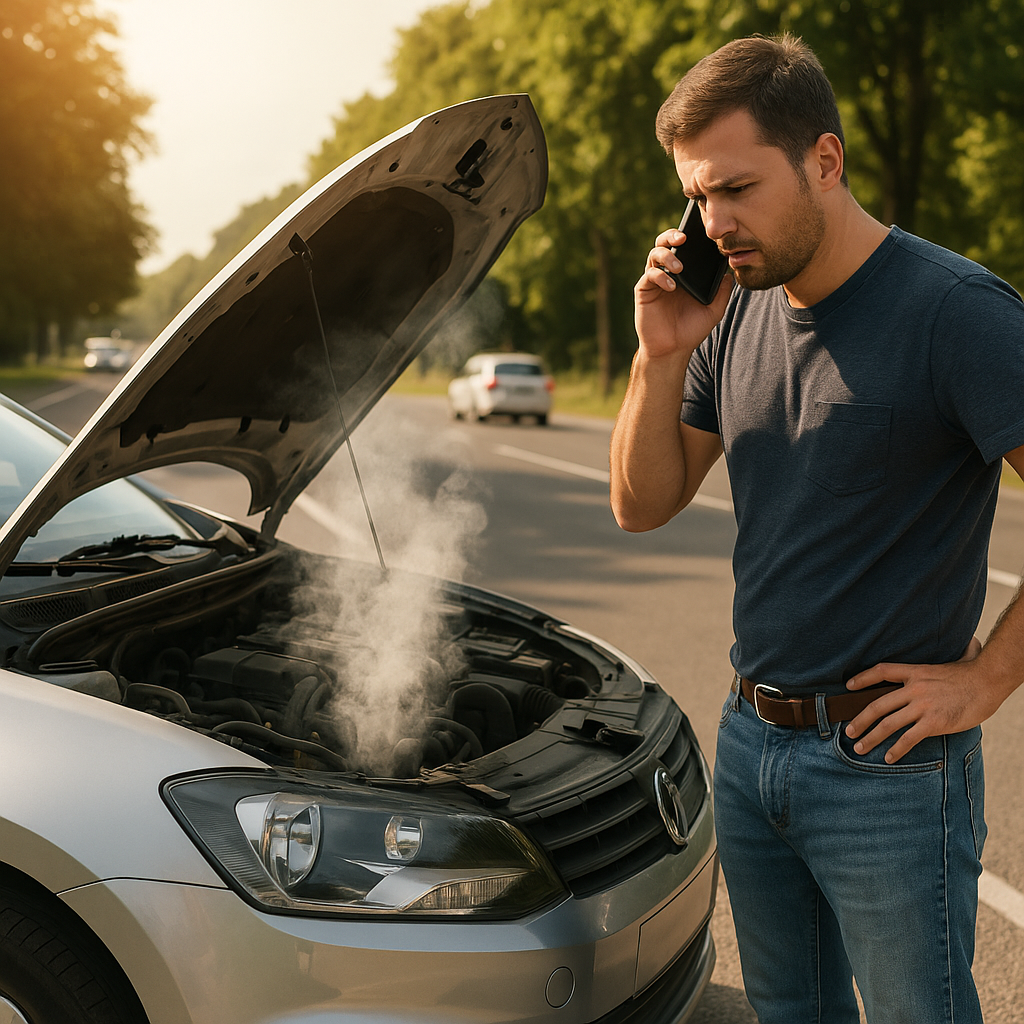
July in Cary: 95 degrees, humidity you can lean on, and I-40 westbound stopped solid from Wade Avenue to the RTP exits. This is when cooling systems that were “fine” all spring give up. Overheating is the second most common summer breakdown tow operators see after dead batteries, and it is the one where the driver’s decisions in the first two minutes matter most, because an overheated engine driven one more mile can go from a $150 hose to a $4,000 head gasket or a replacement engine. Here is how to spot it early, what to do the moment the gauge climbs, what not to do, and how to prevent it.
Why summer heat overheats cars
An engine produces the same heat whether the outside air is 40 degrees or 95, but on a hot day the radiator has a much harder time shedding it. Add stop-and-go traffic, where there is no airflow through the radiator except what the fan provides, and the air conditioning working at full load, and a cooling system with any weakness (low coolant, a tired fan, a partially clogged radiator, an old thermostat) falls behind. The problem was always there; summer traffic just exposes it.
Early warning signs
- The temperature gauge creeping above its usual position, even slightly.
- A sweet smell (coolant) from the vents or under the hood.
- The air conditioning suddenly blowing warm; many cars cut the compressor when the engine gets hot.
- A temperature warning light or message on the dash.
- Steam, or what looks like white smoke, from under the hood. That is the emergency stage.
What to do when the gauge climbs
- Turn off the air conditioning. It removes a large load from the engine immediately.
- Turn the heater on full, fan on high. The heater core is a small radiator inside the dash; running it pulls heat out of the coolant. It is miserable in July and it works. Open the windows.
- If traffic is moving, keep moving at a steady speed; airflow helps. If traffic is stopped, shift to neutral and gently raise the engine speed to around 1,500 rpm to spin the water pump and fan faster.
- Watch the gauge. If it comes back down, drive gently to the nearest safe place and have the car looked at before you drive it again.
- If it keeps climbing or the warning light comes on, pull over and shut the engine off. Right away. Not at the next exit. The shoulder, a parking lot, anywhere safe and out of traffic. Every minute of running an overheated engine risks warping the cylinder head.
What not to do
- Do not open the radiator cap or the coolant reservoir cap while the engine is hot. The system is under pressure and the coolant is well above boiling. People are badly burned every summer doing this. Wait at least 30 minutes, and even then open the cap slowly with a rag.
- Do not pour cold water on a hot engine. Thermal shock can crack the block or the head.
- Do not add cold water to the radiator of a very hot engine. If you must add fluid after it has cooled somewhat, add it slowly with the engine running so it mixes.
- Do not “just make it home.” This is the sentence that precedes most engine replacements. A tow is far cheaper.
- Do not restart the car every few minutes to check. Let it cool fully.
Where Cary cars overheat
- I-40 westbound between Wade Avenue and the I-540 split, every weekday from about 4 to 6:30 p.m.
- I-40 eastbound at Harrison Avenue in the morning, where the merge stops traffic dead.
- US-1 / US-64 southbound toward Apex on Friday afternoons.
- Cary Parkway and Kildaire Farm Road at the long lights.
- Parking lots after an event, when everyone idles for 30 minutes trying to leave at once.
Common causes, in order
- Low coolant from a slow leak (a hose, the water pump, the radiator, a heater hose) that went unnoticed.
- Cooling fan not working: a failed fan motor, relay or sensor. The car is fine on the highway and overheats the moment it stops. This is the classic stop-and-go failure.
- Stuck thermostat that will not open fully.
- Clogged or damaged radiator, often from years without a coolant flush, or from debris blocking the fins.
- Failing water pump, often with a whine or a coolant leak from behind the pulley.
- Blown head gasket: white exhaust smoke, milky oil, coolant that disappears with no visible leak. This one usually started as one of the above and was driven too long.
After it cools: drive or tow?
If the overheat was brief, the gauge came back down, coolant is at the right level and you can see no leak, you can drive gently to a shop and have it checked. If the car ran hot for more than a minute or two, if the coolant is low with no obvious reason, if there is any steam or a sweet smell, or if it overheats again within a few miles, have it towed. A tow to your mechanic costs less than a diagnostic on a cooked engine. The featured provider, WTF Towing, will take it to any shop in Cary, Apex, Morrisville or Raleigh you choose. Call (919) 230-4498.
Preventing it
- Check the coolant level in the overflow tank monthly, when the engine is cold. If it needs topping off more than once a season, there is a leak.
- Have the coolant flushed on the manufacturer’s schedule (often every five years or 100,000 miles for modern long-life coolant).
- Have the fan tested each spring: with the engine warm and the air conditioning on, the fan should be running.
- Look at the radiator fins for leaves, plastic bags and bugs. Rinse gently from the engine side.
- Replace hoses that feel mushy or crunchy, and any hose more than ten years old.
- If the temperature gauge has ever behaved oddly, do not wait for summer to find out why. The seasonal maintenance checklist covers what to check and when.
Frequently asked questions
Can I add water instead of coolant in an emergency? Yes, once the engine has cooled, to get to a shop. Have it flushed and refilled with the correct coolant afterward.
The gauge went into the red for a few seconds. Is the engine ruined? Probably not, if you shut it down promptly. Have it inspected before driving it again.
Why does it only overheat in traffic? Almost certainly the cooling fan. On the highway, airflow cools the radiator; in traffic, the fan has to do it alone.
Do EVs overheat? Rarely, but their batteries and motors have cooling systems too, and a coolant warning on an EV should be taken as seriously as on a gas car. See the EV guide.
WTF Towing – 24/7 towing and roadside help in Cary, NC.
Answered 24/7 · WTF Towing in Cary