

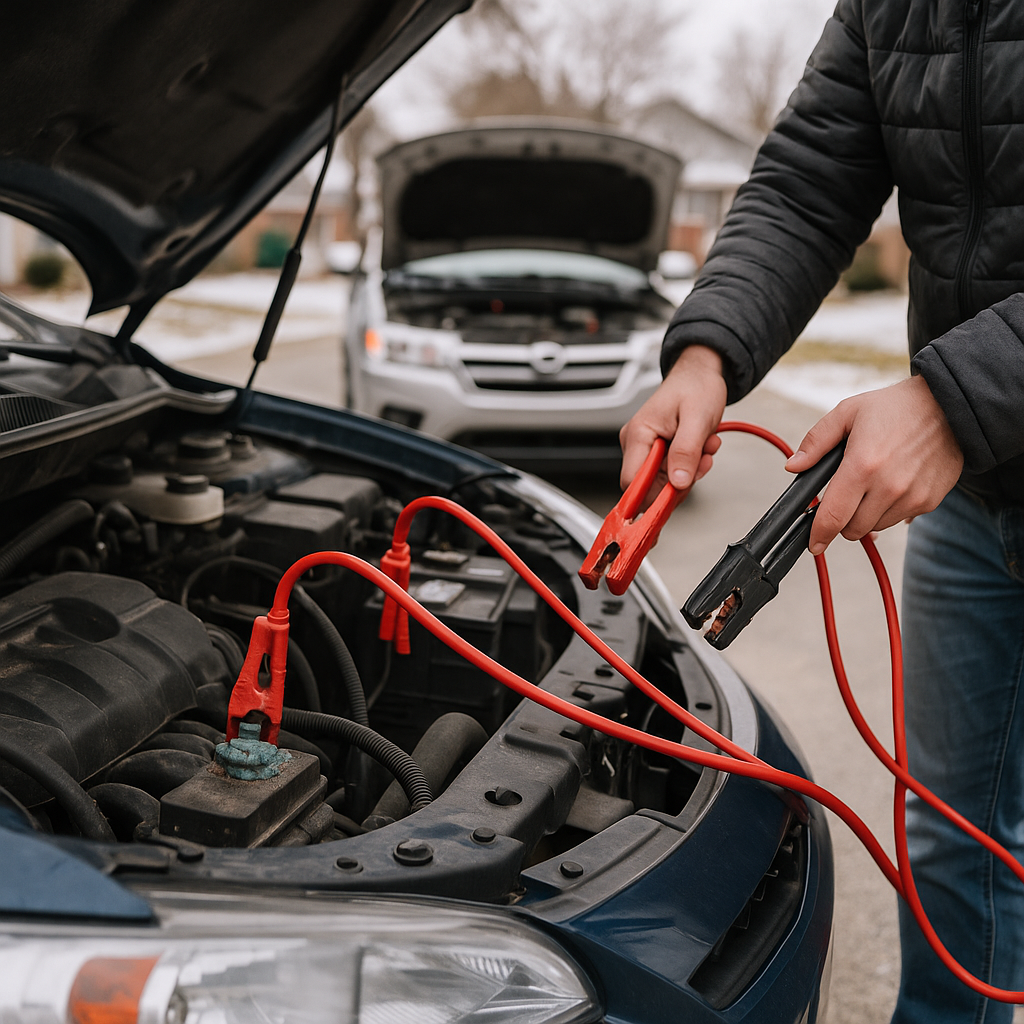
You turn the key and get a click, a slow groan, or nothing at all. A dead battery is the single most common reason people in Cary call for roadside help, and it is also the one you are most likely to handle wrong. Modern cars are packed with sensitive electronics, and a jump start done in the wrong order can cost more than a new battery. Here is how to tell a dead battery from something worse, how to jump it safely, the mistakes tow operators see every week, and when it makes more sense to call a professional.
Is it really the battery?
Before you drag out the cables, read the symptoms.
- Rapid clicking, dim dash lights, no crank. Classic dead battery. A jump will almost certainly work.
- Slow, laboring crank that never catches. Weak battery, or a battery that is fine but the engine has another problem. Try a jump; if it cranks fast but still will not start, the problem is fuel or ignition.
- Cranks normally but will not start. Not the battery. A jump will not help. This needs a tow to a shop.
- Single loud click, then nothing. Often a starter. A jump sometimes works once, but the fix is a starter, not a battery.
- Everything dead, not even dome lights. Fully flat battery or a loose terminal. Check that the cable clamps are tight before anything else.
Why do batteries die so often here? Triangle summers run the electrolyte hot and shorten battery life; the first cold snap in late fall then exposes the weakness. Three to four years is a typical lifespan in Cary. If your battery is older than that and the car has been slow to start, you are on borrowed time.
How to jump-start a car safely, step by step
You need a working car (or a portable jump pack) and a set of cables in good condition. Read the owner’s manual first: many newer cars, especially European models and hybrids, have a dedicated jump post under the hood and a battery in the trunk you should not connect to directly.
- Park nose to nose or side by side so the cables reach, without the cars touching. Both cars off, in park, parking brakes set.
- Red clamp to the dead battery’s positive (+) terminal. Make sure it bites clean metal, not the plastic cover.
- Other red clamp to the good battery’s positive (+).
- Black clamp to the good battery’s negative (−).
- Last black clamp to bare metal on the dead car’s engine block or a marked ground point, away from the battery. This is the step people skip. Connecting the final clamp directly to the dead battery can create a spark right next to hydrogen gas the battery vents.
- Start the good car and let it run two to three minutes at a fast idle.
- Try the dead car. If it does not start in a few seconds, wait another few minutes and try again. Do not crank for more than ten seconds at a time.
- Once running, remove the clamps in reverse order: black from ground, black from good battery, red from good battery, red from the formerly dead battery.
- Drive at least 20 to 30 minutes, ideally at road speed, before shutting the car off again. Idling in the driveway does not put much back into the battery.
Jump-start mistakes that damage cars
These are the ones tow operators see most around Cary, in order of how expensive they get.
- Reversing polarity. Red to negative, black to positive. On an older truck this blows a fuse. On a newer car it can destroy the engine computer, the body control module and the infotainment system. If you cannot clearly read the + and − marks, stop and use a light.
- Letting the clamps touch each other while connected to a live battery. Instant short circuit, melted clamps, sometimes a fire.
- Using cheap, thin cables. Bargain cables have too little copper to carry starting current. They get hot, the insulation softens, and the car still does not start. Look for 4-gauge or heavier, at least 12 feet long.
- Jumping a frozen or swollen battery. If the case is bulging or cracked, or it is below freezing and the battery has been dead for days, do not jump it. It can rupture.
- Connecting the last clamp to the dead battery’s negative post. See step five above. This is the spark-at-the-battery mistake.
- Revving the donor car hard. A fast idle is plenty. Voltage spikes from hard revving can damage electronics in both cars.
- Turning the dead car’s accessories on while cranking. Headlights, blower, radio and rear defrost should all be off so every amp goes to the starter.
Jump packs versus cables
A lithium jump pack the size of a paperback book will start most cars and lives in your glove box. It removes the need for a second car and most of the polarity risk, because good packs refuse to deliver current if the clamps are backward. Keep it charged; a pack that has sat for a year in a hot car is often as dead as the battery you are trying to save. Cables are still worth carrying as a backup and for helping someone else.
Hybrids and electric vehicles
Hybrids and EVs have a regular 12-volt battery that runs the computers and locks, and it dies just like any other. Most can be jumped through a marked post under the hood, but the procedure differs by model and you should never try to jump another car from a hybrid or EV’s 12-volt system. If you are unsure, call for a mobile jump start; WTF Towing’s drivers see these cars every day and know where the jump points are. More on that in the EV and hybrid towing guide.
When to skip the jump and call for help
- You are on a highway shoulder. Standing between two cars on the side of I-40 or US-1 is not worth it. Stay in the car and call.
- You are alone at night in a parking deck or an unfamiliar lot.
- The battery is swollen, leaking, or smells like rotten eggs.
- The car jumped fine yesterday and is dead again today. The battery, or the alternator that charges it, is finished. A second jump only gets you to a shop, so you might as well have it towed there directly.
- You do not have cables, a jump pack or a second car, which is most people at 6:30 in the morning.
A mobile jump start from the featured provider, WTF Towing, gets a truck with a professional booster to your driveway, office lot or parking deck anywhere in Cary, Apex, Morrisville, Holly Springs or RTP. The driver checks the charging voltage after the car starts and tells you honestly whether the battery will hold or whether you are headed for a repeat. If it will not hold, the same truck can tow it straight to your shop. See jump start service for details.
Where Cary cars get jump-started most
Office parks along Weston Parkway after a long weekend, the parking decks at Fenton and Park West Village, the lots at Waverly Place and Crossroads Plaza where a dome light got left on during a long dinner, and the commuter lots near the Cary train station. If you are in a garage, note the level and the nearest pillar number when you call; it saves the driver a lap.
Preventing the next one
- Have the battery load-tested every fall once it turns three. Most parts stores do it free.
- Clean corrosion off the terminals with a wire brush and a little baking soda and water.
- If the car sits for more than two weeks, use a maintainer or start it and drive it for half an hour.
- Replace the battery at the first slow crank. Waiting rarely saves money.
Frequently asked questions
How long should I drive after a jump? At least 20 minutes at speed. If the car sits overnight and is dead again, the battery needs replacing.
Can a jump start damage my car? Done correctly, no. Done backward or with the clamps touching, yes, and badly.
Will they replace the battery on the spot? Roadside service means a jump start and, if needed, a tow. If the battery will not hold a charge, the car goes to the shop of your choice.
What does a jump start cost? Less than a tow, and far less than a new engine computer. Call (919) 230-4498 for a price before a truck rolls.
WTF Towing – 24/7 towing and roadside help in Cary, NC.
Answered 24/7 · WTF Towing in Cary